Get Full Government Meeting Transcripts, Videos, & Alerts Forever!
Get email alerts on the Parks Recreation topic
No spam. Unsubscribe anytime.
City administrator urges engineering estimates and grant push for Evergreen Park pickleball courts
Summary
City Administrator Mike Welty told the St. Clair Park Board he will push for engineering estimates and pursue grant funding, including a T‑Mobile grant, to build pickleball courts at Evergreen Park; a local volunteer who builds courts said tournaments can draw regional visitors but funding and formal approvals are prerequisites.
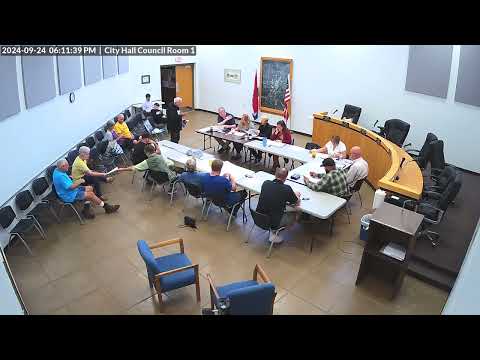
City Administrator Mike Welty told the St. Clair Park Board that he will work to move a proposal for pickleball courts at Evergreen Park toward the Board of Aldermen and said the board should secure engineering cost estimates before seeking grant funding.
Welty, who introduced himself as the city’s new administrator, said he will attend Park Board meetings regularly while he learns local priorities and described the formal process: the Park Board must vote on a proposal and send a document to the Board of Aldermen, after which Welty said he will place the item on an aldermanic agenda and report back to the Park Board. “At least for the rest of this year I’ll probably be at every one of your needs,” he said.
A resident introduced in the meeting as Mr. Berer described how nearby municipalities have used pickleball courts to increase park use and draw tournament visitors. He cited past tournaments that drew hundreds of players and visitors from multiple states and said smaller community courts can still be heavily used. “If you built basketball courts on that southern end … you could have a tournament,” he said.
Speakers advised the board to obtain engineering drawings and cost estimates before applying for grants. Welty said he expects the engineering phase to take about a month to six weeks and noted that aldermanic meetings occur on the first and third Mondays, so any contract or budget request must align with that schedule.
Funding options discussed included the T‑Mobile grant (described in the meeting as a quarterly program with awards about six weeks after the quarter closes and a one‑year spending window) and federal grant programs. The meeting record includes two grant details repeatedly raised by speakers: the Land and Water Conservation Fund (LWCF) is a 50/50 grant that can place long‑term use restrictions on park property, and a separate RTP program was described as an 80/20 grant. “TMobile Grant is a full Grant … it's a $50,000 cash Grant so it's just that's it,” the resident said (grant amounts and program rules were stated in the meeting transcript).
Board members and volunteers discussed construction choices (asphalt vs. concrete), lighting, utility access and winter temperature constraints for paving; speakers said many decisions depend on the final engineering scope and bid results. If the board secures engineering estimates and a qualifying grant, participants said construction could feasibly begin in early spring but stressed multiple contingencies: grant award, engineering completion, aldermanic approval and a public bid process.
Next steps recorded in the meeting: the Park Board will request at least two engineering cost estimates to build a budget number for aldermanic consideration; Welty said he would follow up with the engineering firms and help coordinate their site visits. The Park Board also planned to re-contact local donors and volunteers who have supported park work in the past.
The board did not take a formal vote on a construction contract at the meeting; Welty said he would place any formal request on a future Board of Aldermen agenda once the Park Board had a documented proposal and cost estimate.