Get Full Government Meeting Transcripts, Videos, & Alerts Forever!
Get email alerts on the School Buildings Energy topic
No spam. Unsubscribe anytime.
PGCPS details $11 million in rebates, ESCO planning and operational savings as it pushes to cut building emissions
Summary
At a June 24 Climate Change Action Plan ad hoc committee meeting, PGCPS staff reported more than 280 energy projects tied to roughly $11 million in utility rebates, an RFP under way for electric bus chargers, LED retrofit progress and plans to issue an ESCO solicitation next year; a Power Takeoff case study estimated $164,000 in annual operational savings.
Prince George’s County Public Schools’ climate oversight committee received an update June 24 on its Priority 2 work to reduce the district’s building carbon footprint, including $11 million in utility rebates, progress on solar and electric bus infrastructure, and plans to pursue an ESCO to tackle underperforming schools.
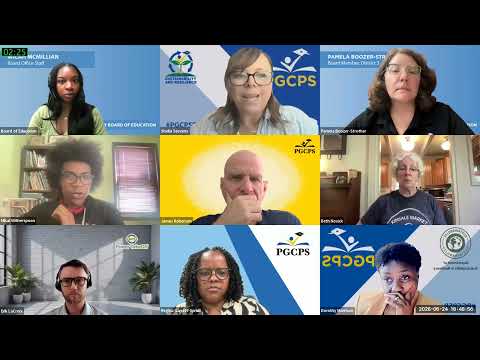
“We have over 280 projects … utility rebates are equating to about $11 million so far,” Sheila Stevens, program manager in the Department of Sustainability and Resilience, told the Climate Change Action Plan ad hoc committee. The committee met without a quorum and proceeded under suspended rules to hear presentations rather than take votes.
Why it matters: The district’s financing and operational choices will determine how quickly aging school systems are upgraded, whether solar and geothermal projects are prioritized and how much capital spending must be covered locally versus stacked grant and rebate funding.
Stevens said the district is pursuing multiple funding sources so it does not have to rely on routine school operating budgets. She cited two Maryland decarbonization grants currently supporting Priority 2: a recently completed lighting project at a district elementary school and a grant used to fund a utility-billing management subscription. On lighting, Stevens said nine whole-school LED replacements have been completed since December and 14 more are queued.
On solar and buses: Stevens said six schools are in permitting or installation for rooftop solar and that three schools were recently brought online (school names are stated in the transcript). She also confirmed the district has 21 electric school buses but has lacked adequate charging infrastructure; an RFP to install chargers at Crossland and Greenbelt closed in May with four proposals and a vendor award is expected by the end of the month or early next month.
ESCO planning: To address a large portfolio of aging, underperforming buildings, the district is evaluating energy service company (ESCO) alternatives. Stevens said the district hopes to develop an RFP this fall and to issue a solicitation in the spring to engage one or more ESCOs to do systemwide audits and recommend energy conservation measures.
Operational savings case study: Eric Lacroy, an energy adviser with Power Takeoff, presented the district’s experience with a virtual commissioning program. “Out of the 11 projects that have been invoiced, have saved roughly around $164,000 in savings,” Lacroy said, describing the figure as an estimated annual savings that comes from schedule optimization, set-point adjustments and other low-cost operational changes. He also highlighted a modeled 36% reduction in energy usage at one high school after adjustments.
Limits and next steps: Both presenters cautioned that some savings depend on building automation and consistent schedules. Lacroy and Stevens identified common roadblocks — community or parks-and-recreation use of facilities after hours, legacy buildings without automation, seasonal overrides and equipment failures — that can blunt the savings potential. Stevens said the district has been cleaning and re-enrolling utility meter data (more than 1,000 meters/accounts) and expects the vendor enrollment process to take roughly eight weeks.
Recycling, community grants and facilities consolidation: Stevens also reported the district has diverted more than 2.5 million pounds of material from landfills this school year (about 2 million pounds recycling and more than 422,000 pounds compostables), noted a Chesapeake Bay Trust resiliency-hub grant awarded to the Langley Park Civic Association, and described plans to consolidate administrative offices and demolish two vacant buildings using Inflation Reduction Act funds.
No formal votes were taken at the meeting because the committee lacked a quorum; the agenda and the minutes were adopted under the chair’s suspension of procedural rules. The committee’s next virtual meeting is scheduled for Aug. 19, 2026, at 4:30 p.m.
Quotes: Stevens: “We have over 280 projects … utility rebates are equating to about $11 million so far.” Lacroy: “Out of the 11 projects that have been invoiced, have saved roughly around $164,000 in savings.”
What to watch: whether the ESCO solicitation moves forward next spring, the outcome of the electric bus charger vendor procurement, completion of the vendor utility enrollment and modeling results for projects currently in the pipeline.