Get Full Government Meeting Transcripts, Videos, & Alerts Forever!
Get email alerts on the Discretionary Grants topic
No spam. Unsubscribe anytime.
Seabrook Island committee keeps rolling approval, adopts binary recommendations for discretionary grants
Summary
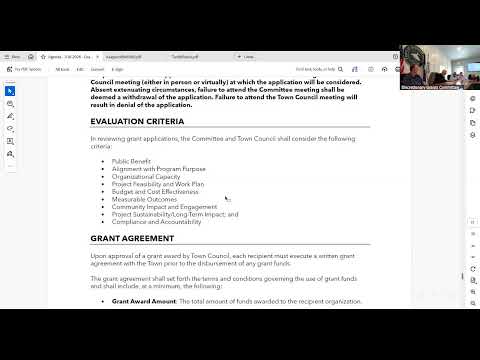
The committee set the discretionary-grant application to open April 1 for a $30,000 fund (up to $5,000 per applicant), kept a rolling-approval process for 2026, and voted to send binary recommend/deny recommendations to town council while allowing members to use private numeric scores for their own assessment.
Seabrook Island — The town’s discretionary-grants committee clarified how it will evaluate requests and set the application timetable during a special meeting on a March date in mid‑March.
Joe (staff member) told the committee the town will post the application on the discretionary-grant webpage and "we're planning to start accepting the applications April 1st." He also confirmed the committee will receive application packets at least 72 hours before each meeting and said the committee’s available fund for the year is about $30,000, with a single applicant able to request up to $5,000.
The committee discussed new language in recently adopted guidelines that allows funding of projects that are not strictly inside town limits, described in the meeting as a "good neighbor" provision. Members cited local examples including Backpack Buddies and a barrier‑island clinic when weighing whether groups that are based off-island but that respond to Seabrook calls should remain eligible.
A central debate concerned selection policy. Some members favored keeping the inherited "first come, first served"/rolling approval model to preserve flexibility for needs that arise later in the year. Others argued for establishing a scoring floor or a more formal point system to provide transparent feedback to applicants and to help council prioritize awards. One participant illustrated the difficulty of scoring projects strictly by the line‑item request, using an injured‑wildlife responder that asks for cages but whose main value is its availability to respond when animals are found.
After discussion, the committee voted to use a binary recommendation — approve or deny — when reporting to town council, while individual members may keep private numeric scores for their own decision‑making. The motion to adopt the binary recommend/deny method was seconded and carried on a voice vote.
Committee members also debated whether to qualify recommendations with a second tier such as "highly recommend." A proposal to adopt a three‑level recommendation ("highly recommend," "recommend," "do not recommend") failed for lack of a second.
On scheduling, the committee approved changing its regular meeting time to 10:00 a.m. on the third Wednesday of the month going forward. For the upcoming April grants meeting, members agreed to move the meeting date to April 22 and hold that session at 9:00 a.m. to allow applicants and staff more preparation time.
The committee emphasized that it is a recommending body: its decisions will go to town council, which retains final approval authority and may approve applications the committee recommends against. Members discussed the practical consequences of recommending partial funding (for example, recommending less than an applicant requested) and noted committees should ask applicants at the time of presentation whether a reduced award would make the project infeasible.
The committee expects to begin accepting applications on April 1 and to have applicants on the agenda for the April meeting; staff said applicants who do not attend the committee presentation may be considered withdrawn under the adopted attendance rule.
The meeting concluded after agreeing the committee will try the clarified procedures this year and revisit scoring or a fixed application deadline for 2027 if needed.