Get Full Government Meeting Transcripts, Videos, & Alerts Forever!
Get email alerts on the Charter Application topic
No spam. Unsubscribe anytime.
Cherokee County board hears pitch for Academy of Performing Arts charter; officials press on funding, special education and transportation
Summary
The Academy of Performing Arts presented its charter application and community supporters to the Cherokee County School District, promising arts-integrated curriculum, partnerships and a five-year budget; board members pressed applicants on curriculum alignment, support for students with IEPs, transportation logistics, enrollment projections (300 cap) and how state per-pupil funding would affect district finances.
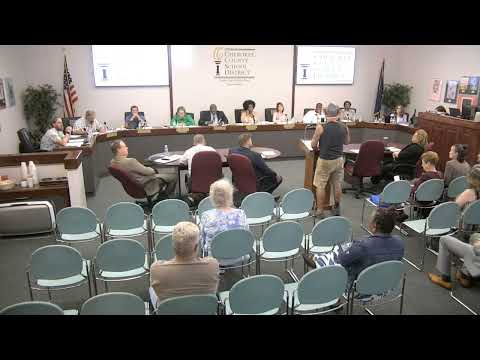
At a Cherokee County School District meeting, proponents of a proposed Academy of Performing Arts charter school outlined partnerships, a five‑year budget and plans to integrate performing arts into core academics, while board members pressed for clearer answers on special education supports, transportation and the fiscal impact of enrollment shifts.
"The Academy of Performing Arts isn't just a school. It's an opportunity to lift academic outcomes, to close academic gaps," said Washa White Fowler, a member of the Academy planning team and a doctoral candidate, arguing the proposal would benefit students across the county. Supporters in the audience said hundreds of local residents and organizations back the project and that existing partnerships (including with local radio and theater groups) would support programming.
The presentation described partnerships with WCCQ radio station, Gaffne Little Theater, the School Instrument Foundation and the Kids Club of Cherokee County to provide broadcasting, summer programming and after‑school supports. The applicants said they had engaged consultants for finance and charter accounting and had submitted a five‑year budget prioritizing classroom instruction.
Several community members gave public testimony. "The arts train the mind," said Jessica Miranda, a local business owner and former dancer, who cited academic gains she said were associated with strong arts education (she cited figures she described as roughly +0.6 standard deviations in language, +0.3 in math and +0.5 in GPA). Peter Wagner, a local parent, urged the board to view the Academy as a partner rather than a competitor and said the proposal appeared designed to bring additional resources into the district.
Board members then conducted a focused Q&A with applicants. On curriculum alignment, applicants said they plan to use the Core Knowledge curriculum with a newly added arts‑integration component and that alignment issues were addressed in the application appendices. On supports for students with IEPs and other needs, applicants said services will depend on enrollment and staffing; they plan an after‑school tutoring program and said they are applying for a $100,000 grant to help fund those supports.
Admissions, lottery and leadership questions drew detailed exchanges. Applicants confirmed they would use a standard lottery if applications exceed seats and said they would not be permitted to select students on the basis of IEP or 504 status. The group said a principal would be accountable on day one and cited members of their planning team with district and higher‑education experience, while acknowledging some planning members had not previously opened an independent charter school.
Finance and enrollment questions were central. Board members warned that state funding generally "follows the child," meaning district allocations change when students enroll elsewhere. The applicants acknowledged that and said the district could recapture some funds if the school is chartered through the district; the presentation and discussion also referenced differing per‑pupil figures that were not resolved during the meeting (applicants and board members cited figures in discussion but did not produce a single reconciled per‑pupil budget figure during the public Q&A).
On transportation, applicants said charter law provides different requirements and that they have submitted appropriations requests to Representative Brian Lawson for bus funding; they said the share of students needing district‑provided transportation would be estimated after enrollment is finalized.
Applicants described multiple strategies for funding facilities and equipment, including a financing relationship with a nonprofit referred to as "building hope," state appropriations requests for instruments and buses, and grant connections through a local contact, Vance Hammond, and the Boys & Girls Club network.
Board members repeatedly asked whether the district could deliver similar arts programs without creating a separate charter. Officials acknowledged shared goals of expanding arts instruction but said resource constraints and differing approaches left several unanswered operational questions. The public portion ended with a procedural motion: Mr. Greer moved to adjourn the public portion, Miss Shacker seconded, and the meeting stood adjourned.
The board did not take a final vote on charter approval during this session; questions about exact per‑pupil funding, the final enrollment split, transportation obligations and the specific staffing plan for special education remain unresolved. The applicants said they will provide additional documentation and that some operational details will be finalized once enrollment and facility location are confirmed.
What happens next: the board will consider the submitted application and appendices alongside the rubric it completed; applicants indicated they will continue outreach and refinement of operational plans and funding requests.