Get Full Government Meeting Transcripts, Videos, & Alerts Forever!
Get email alerts on the Cell Coverage topic
No spam. Unsubscribe anytime.
Carriers and emergency responders say a second cell tower would close coverage gaps on Seabrook Island
Summary
Apex Towers and public‑safety officials told the Seabrook Island Public Safety Committee that foliage and the single water‑tank site limit coverage and capacity; carriers have signaled support for a monopole near the driving range but approvals and construction would take at least a year and require carrier contracts.
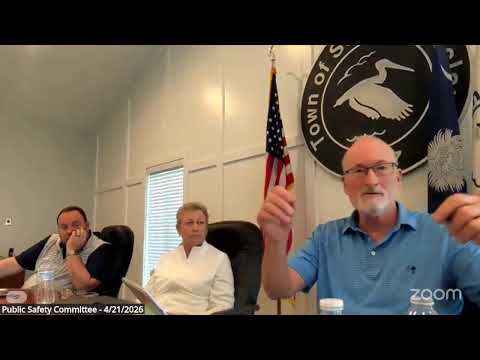
Seabrook Island public‑safety and telecommunications experts told the Public Safety Committee April 24 that a second cell tower is the most practical way to reduce coverage gaps that affect 911 reachability and mission‑critical data for first responders.
David McClure, president of Apex Towers and a Seabrook resident, presented carrier propagation maps and letters from Verizon and T‑Mobile saying the single water‑tower site does not deliver full 5G or reliable in‑building service across the island. "That one tower isn't adequate to serve Seabrook Island," McClure said, describing how foliage and the water tower's limited height reduce mid‑band 5G propagation. McClure showed a graphic simulation of a proposed monopole near the driving‑range maintenance area and said carriers were willing to lease space but he would not build without signed carrier contracts.
Deputy Fire Chief Kevin Hansen, speaking for the fire district, said the department has invested in a $1.5 million radio system that uses SIM‑enabled radios and mobile data terminals; those systems rely on LTE/5G as primary or failover links for maps, dispatch information and other mission‑critical data. "Being able, particularly on the beach, ... to notify 911, that's super important," Hansen said, adding that dropped calls and poor mobile data can materially hamper rescues and incident response.
Committee members pressed McClure on alternatives. He said small cells (low‑power poles) would require roughly 35–50 installations across the island and fiber to each site, making small cells costly and operationally complex compared with a single monopole. He estimated permitting, environmental work, zoning adjustments and carrier approvals would take on the order of 9–12 months to a year and urged the committee to treat carrier commitments as preconditions: "I will never build a tower until I have T‑Mobile or Verizon under contract," he said.
McClure said Verizon and T‑Mobile provided letters noting that improving the network footprint would strengthen network resilience, capacity and life‑safety connectivity. He also said AT&T historically has been less active on similar local tower builds and might take longer to participate.
The committee asked staff to draft a report capturing the technical and public‑safety case for improved coverage and to consider a nonbinding recommendation for council or other authorities. No zoning decision or formal town action was taken; committee members recognized that siting or rezoning would involve other municipal bodies and Charleston County permitting.
Next steps identified included collecting the carriers' formal technical responses (as permitted), asking staff to prepare a committee report for the next meeting, and coordinating with the club and county staff on potential sites and required approvals. McClure cautioned that even with a timely schedule, residents should expect at least a year before any ground‑disturbing construction could begin.