Get Full Government Meeting Transcripts, Videos, & Alerts Forever!
Get email alerts on the Transportation topic
No spam. Unsubscribe anytime.
Candela representatives pitch hydrofoil electric ferries, U.S. manufacturing in Beaufort–Jasper region
Summary
A Candela representative told the meeting the company wants U.S. production and pitched hydrofoil electric ferries as a low‑energy, fast link for Beaufort and Jasper counties, while officials pressed on parking, last‑mile transit and regulatory changes required for no‑wake rules.
Didrik Edvardsen, a local proponent working with Candela, presented a proposal to the meeting advocating hydrofoil electric ferries and potential U.S. manufacturing for the company’s vessels. He showed a video and said Candela sees strong global demand and is seeking an American manufacturing base to meet Jones Act requirements.
Edvardsen said the hydrofoil vessels could cut long cross‑county trips to 15–20 minutes and expand workforce access to Hilton Head and other job centers. He described the vessels as carbon‑fiber, low‑wake hydrofoils that “consume 90% 90% less energy” and require much less routine maintenance than conventional ferries, enabling lower fares — he cited a $5 one‑way fare as an example of feasible pricing.
The presentation included technical and commercial details: the company’s video features Gustav Skog, founder and CEO of Candela, describing the product and the firm’s focus on ramping production. Edvardsen cited vessel specifications discussed in the presentation: typical operating speed 25–30 knots, foiling beginning around 12 knots, a draft of about 3 feet, nominal capacity of roughly 30 passengers, and an operational radius of about 40 miles. He also said turnaround charging times could be short (Edvardsen estimated a practical turnaround of about 10 minutes) and that the vessels could be transported by road on a 16‑wheeler when needed.
Edvardsen presented financial and economic estimates drawn from company modeling: a suggested per‑vessel unit cost around $3.8 million, an estimated regional market of 100–200 ferries, and a hypothetical local business scale “roughly around that number” in the hundreds of millions if production is sited in Jasper County. He added that many investors back the company (he named the World Bank and CalPERS among funders in the presentation).
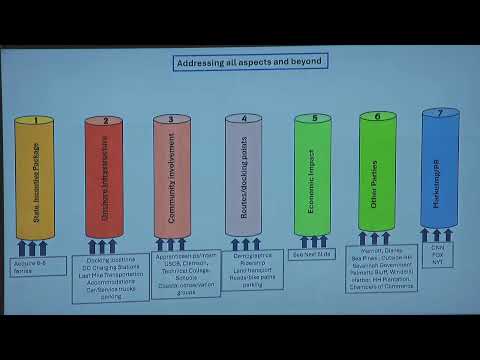
State and local support described in the presentation included an offer of Department of Commerce assistance (which Edvardsen described as $28 million in job‑training and related support), a proposed $3 million maritime division under the state DOT, and a $2 million statewide maritime study being pursued. Edvardsen said site searches have included industrial parks and waterfront facilities in Jasper and Beaufort counties and that an initial production facility could be roughly 100,000 square feet with overhead cranes and paint shop capacity.
Committee members and other attendees pressed on several operational and local‑government implications. Questions focused on ridership assumptions and where to locate parking and embarkation facilities: members noted that using county boat landings for commuter parking could cut into recreational access and said parking garages or other shore infrastructure would likely fall to counties or municipalities. Edvardsen acknowledged those constraints and urged last‑mile planning, citing coordination with Palmetto Breeze and DOT as necessary to make ferry routes practical.
Regulatory issues raised included South Carolina’s no‑wake law, which Edvardsen said could limit operations because the boats foil at about 12 knots; he said Senator Davis would seek to address the statute and that the Coast Guard would need to be consulted for operations in crowded waters. On finance, Edvardsen contrasted the Candela concept with earlier public‑subsidy examples, noting a Miami diesel water taxi that ran at high occupancy only when free and later proved unsustainable as a county subsidy; he argued Candela’s energy efficiency and lower operating costs could allow private operators to operate without long‑term county subsidies.
Edvardsen offered to distribute a corporate presentation and said Candela could initially deploy three vessels and scale up, with potential early routes including Daufuskie Island, St. Helena and Savannah. He also posed some discretionary estimates — for example, suggesting potential property‑value increases near service — and characterized some of those figures as tentative.
What happens next: Edvardsen asked to coordinate with local transportation committees and staff to examine last‑mile links, shore infrastructure, siting and regulatory hurdles. The meeting accepted the presentation and moved on to the next agenda item. No formal action or vote on the proposal was taken at this meeting.