Get Full Government Meeting Transcripts, Videos, & Alerts Forever!
Get email alerts on the Urban Forestry topic
No spam. Unsubscribe anytime.
Consulting arborist presents borough tree inventory, recommends online database for management
Summary
Consulting arborist Grace Lon told the Woodcliff Lake Borough Council that a recent inventory counted 5,456 public trees across 147 species, found 91% require only routine maintenance, and recommended using the AR Pro online database to track condition, photos and work lists for DPW and committee admins.
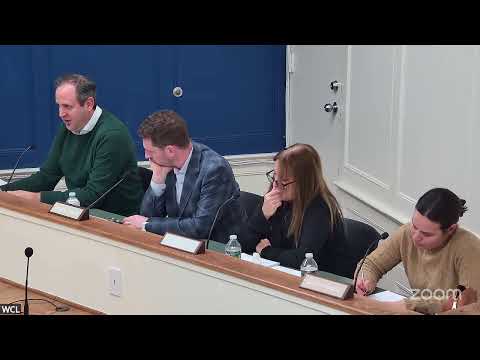
Consulting arborist Grace Lon presented the findings of a borough tree inventory to the Woodcliff Lake Borough Council and urged the municipality to use an online, dynamic database for ongoing management. "The Woodcliff Lake trees are in wonderful condition," Lon said, reporting that the inventory identified 5,456 public trees and 147 distinct species.
Lon said the inventory assessed species, health and public-safety risk. He reported that roughly 91% of public trees require only routine maintenance and that a small number of trees were identified as immediate hazards requiring attention. Lon noted the inventory also assigns monetary values to trees; he gave an example, saying one particularly large specimen was valued at about $111,000 under accepted appraisal formulas.
The arborist demonstrated AR Pro, the platform the committee used to store the data, showing the council how each tree's entry can include address, species, diameter-at-breast-height, condition ratings, photos and notes. Lon said the tool can generate work lists for DPW contractors and can be viewed in a web browser by residents if the borough chooses to publish a link. "This software is a wonderful, valuable tool," he said, and noted committee and DPW staff will have access and a small set of administrative users will be able to update records.
Councilmembers asked about public access, training and costs. Lon and committee members said training for administrators was scheduled imminently; the consultant and council indicated the most common public-facing approach would be a simple link on the borough website rather than providing edit credentials to residents. They also said photographs and Google Street View links in the database will help staff rapidly assess whether a tree's condition has changed since the last inspection.
Next steps identified by council and staff included completion of the scheduled software training, designation of one or two administrative users from the Shade Tree Committee and DPW, and a committee recommendation about whether and how to publish a public-facing link. The Shade Tree Committee and DPW will use the database to prioritize routine trimming and to schedule work on the handful of trees flagged as immediate risks.