Get Full Government Meeting Transcripts, Videos, & Alerts Forever!
Get email alerts on the Infrastructure Project topic
No spam. Unsubscribe anytime.
University City residents press MSD over tunnel plan as agency outlines home buyouts and multiyear construction
Summary
At the Jan. 12 University City Council meeting, residents pressed Metropolitan St. Louis Sewer District representatives about planned property buyouts and demolition for a tunnel project; MSD outlined preconstruction surveys, relocation assistance and multiyear construction estimates.
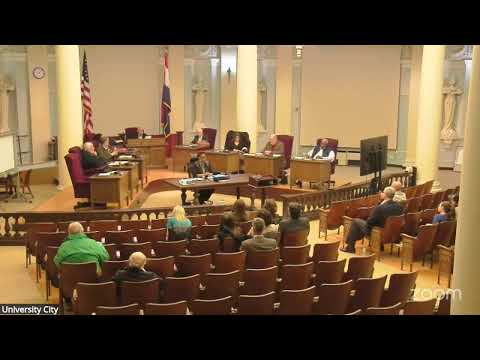
At the Jan. 12 University City Council meeting, residents and council members pressed representatives from the Metropolitan St. Louis Sewer District on how a planned tunnel and shaft project will affect homes in the Amherst corridor and nearby blocks.
MSD representatives told the council and the public that several homes identified near the Amherst drop shaft would need to be purchased and removed to allow construction of a drop shaft serving a new tunnel intended to collect combined sewer overflows. MSD said demolition of individual properties would likely take “a few months” per site, while specific construction activities at a site could last about two to three-and-a-half years; MSD described the overall program timeline as spanning multiple years and noted different contractors would mobilize for different phases.
The agency also described several measures it said would be included in contract specifications. MSD said contractors will perform preconstruction condition surveys for properties within roughly a 500‑foot radius of shaft locations (internal and external inspections if the owner permits), carry insurance, and establish a written claims process for damage to foundations, basements, lateral sewers or yards. MSD also committed to odor control systems for operational vents and said no new pump stations are planned in University City as part of the tunnel project; the agency said near‑surface sewers will be used to connect permitted CSOs to the tunnel.
Residents expressed sharp concerns about scope and communications. State Representative Jeff Hails told MSD that its outreach has been inadequate and warned of “a trust deficit” that stretches beyond University City. Resident Michael Reid described his household’s likely losses in detail — including a professional recording studio in his basement and the prospect of a years‑long construction site across the street — and asked the agency and city to provide “real answers” and meaningful mitigation rather than token gestures.
MSD provided technical details when asked by council members: staff said the main tunnel running from Shrewsbury to the Purdue Avenue shaft is about an 18‑foot diameter tunnel; the three connecting tunnels are about 12 feet in diameter; the Amherst shaft was described as about 20 feet and another large shaft as about 45 feet; MSD said the Purdue Avenue shaft will be the largest and is the point where material will be hauled off site. MSD also said it will consider sound/noise barriers, tree replacement, landscape screening and neighborhood advisory participation to guide aesthetic and maintenance decisions.
On resident compensation and relocation, MSD said it uses a consultant to administer Uniform Relocation Act requirements and would work to provide equivalent, decent, safe and sanitary housing within the area where practical. MSD committed that claims procedures and preconstruction documentation would be part of contractor specifications.
Council members asked about broader fiscal implications for University City — including lost tax base from property acquisitions — and MSD responded that those questions will be part of ongoing discussions as design advances. The agency said it expects to develop written post‑project land‑use and maintenance plans at 60% and 90% design milestones in coordination with city staff, council members and the public.
The council did not take formal action on the tunnel project itself at the meeting; much of the discussion was a question‑and‑answer session and public comment. Council members and residents said they will press MSD for clearer schedules, written standards for mitigation and an ongoing local advisory role as design work continues.