Get Full Government Meeting Transcripts, Videos, & Alerts Forever!
Get email alerts on the Zoning Appeal 2226 South Main topic
No spam. Unsubscribe anytime.
Board continues appeal over whether South Main car lot ceased operations
Summary
The Middletown Board of Zoning Appeals continued an owner’s appeal of a zoning administrator’s finding that the automotive sales use at 2226 South Main Street had been discontinued for more than 12 months, giving the owner until August to produce additional evidence of continuous activity.
The Middletown Board of Zoning Appeals on July 1 continued an appeal by property owner Mike Wilkins challenging a city determination that the used-car operation at 2226 South Main Street had been discontinued for more than 12 consecutive months and therefore must conform to current zoning rules.
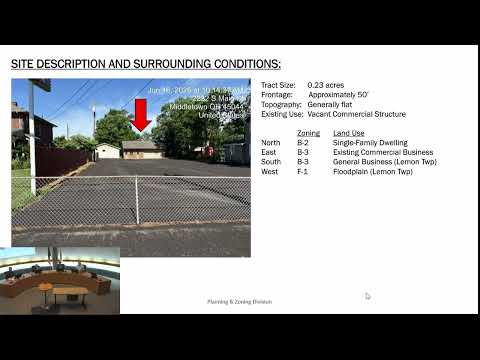
Planning staff told the board the city’s review—based on county pictometry images and city records showing a lack of water service—found no zoning permits or certificates of occupancy for the site after a 2015 certificate tied to a used car business. Staff said the property is approximately 0.23 acres in the B2 district and that the development code requires certain use-specific standards for automotive sales, including minimum lot size and frontage and location on an arterial street.
Mike Wilkins, the property owner, testified he purchased the site in 2010, has leased it as a car lot since then and said the lot was occupied and maintained until April 2026. "It's a car lot. It's always been," Wilkins said, and he offered lease documents, a state dealer license for a tenant and time-stamped photos he said show vehicles on the lot. Attorney for the applicant argued staff’s use of discrete pictometry snapshots and water-service status is insufficient to prove discontinuance.
Board members pressed for "competent, material and substantial" evidence as required to overturn the zoning coordinator’s determination, noting photos alone can be circumstantial and that some records (for example, state dealer sales or local sales-tax documents) may be protected or unavailable without the license holder’s consent. One board member observed that staff had followed the code’s usual investigative sources—zoning permits, certificates of occupancy and pictometry—but that the applicant’s proffered records could change staff’s finding.
Because the applicant asked for time to pursue additional records and the state licensing board declined to release license-holder data without consent, the board voted 4-0 to continue the appeal to the August meeting so the applicant can attempt to produce a paper trail or other evidence.
The appeal remains open; the board did not reverse the staff determination and set the matter for the next meeting to allow the applicant to supplement the record.