Get Full Government Meeting Transcripts, Videos, & Alerts Forever!
Get email alerts on the Water Quality topic
No spam. Unsubscribe anytime.
Presenter warns lakes are now severely hypoxic and urges fall oxygenation to curb cyanobacteria
Summary
Presenter told the lake committee that recent testing shows multiple local lakes have large hypoxic zones and rising cyanobacteria counts, urged installing oxygenation systems this fall, and cautioned that common algicide treatments including copper sulfate can worsen long‑term conditions.
The presenter told the lake committee that recent testing shows several local lakes are now severely hypoxic and at increased risk of toxic cyanobacteria (blue‑green algae) blooms, and urged installing oxygenation systems this fall to reduce next spring's outbreaks.
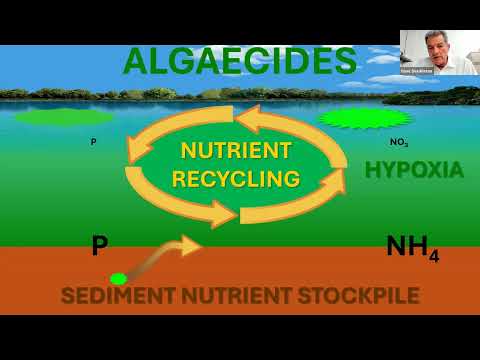
The presenter summarized how eutrophication and sediment accumulation create bottom-layer hypoxia: excess algae die, decompose and form an organic sediment nutrient stockpile that recycles nutrients and reinforces a damaging feedback loop. "The summary is that hypoxia has certainly taken hold ... cyanobacteria are a real and serious threat," he said.
Citing a June 2022 Government Accountability Office report, the presenter noted dissolved‑oxygen profiles are central to management outcomes. He showed site-specific results from field testing: Summer Lake (maximum depth about 10 feet) became hypoxic at roughly 5 feet, which he said represented about 48% of the surface area and 28% of the water volume; Winter Lake (maximum about 20 feet) became hypoxic at about 10 feet (about 28% of the volume and 64% of the surface area). Autumn Lake's data showed a sharp deterioration: the presenter said the lake was hypoxic at 32 feet in June but measured apoxic on Aug. 8 at 16 feet, which he said now affects about 61% of surface area and 44% of water volume.
Laboratory results described by the presenter indicated many small cyanobacterial cells were present even when biovolume appeared modest. He reported that roughly 40% of cell counts were cyanobacteria while biovolume of those organisms was only about 5–10%, a pattern he said could reflect a shift toward smaller, more copper‑tolerant cells. "It would appear we are being drawn into that trap with the copper sulfate treatments," he said.
The presenter cautioned against common short‑term fixes. He said herbicides and algicides can increase sediment nutrient stockpiles by killing biomass that then decomposes, and he warned that aeration systems that only oxygenate upper waters can leave bottom hypoxia unchanged. He cited academic research and the GAO report calling out copper sulfate's limitations and the risk of selecting for copper‑resistant cyanobacteria.
Using Indian Lake as an example, the presenter described an installation timeline: delayed winter installation in 2021 allowed a major spring bloom in 2022 that was harder and more expensive to control. "I would urge you, if at all possible, to start doing something and get things installed this fall because that's going to make a big difference going into next year," he said.
The presenter directed listeners to the project website's "simplify the science" section for detailed, step‑by‑step explanations and additional data. He closed by reiterating that hypoxia has taken hold in the lakes sampled and that timely installation of full oxygenation systems offers the best chance to reduce toxin‑producing cyanobacteria next season.