Get Full Government Meeting Transcripts, Videos, & Alerts Forever!
Get email alerts on the Education Charter Schools topic
No spam. Unsubscribe anytime.
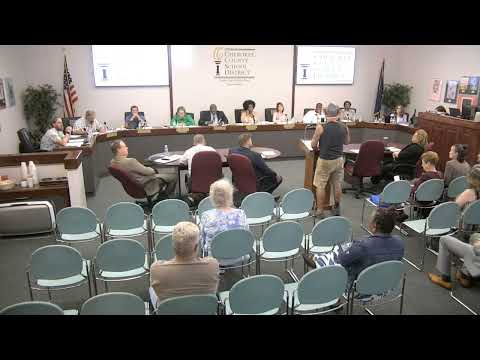
Academy of Performing Arts presents charter proposal; board presses on special education, funding and transport
Summary
The Academy of Performing Arts presented a charter-school application to the Cherokee County School District, stressing arts-integrated curriculum, community partnerships and a five-year budget. Board members questioned curriculum alignment, special-education supports, transportation plans and the fiscal impact on district funding; no vote was taken.
The Academy of Performing Arts (APA) planning team presented a charter-school application to the Cherokee County School District and urged the board to approve a plan that would integrate performing arts into core instruction, rely on local partnerships and use a five-year budget focused on classroom instruction.
The presentation named local partnerships and consultants: WZQ radio for broadcasting, Gaffne Little Theater for summer programming, the School Instrument Foundation and the Kids Club of Cherokee County for after-school support, and financial guidance from Vera CPA, Melissa McCra and a videographer/tech consultant. The presenters said they have submitted a comprehensive five-year budget and are seeking grant and appropriations support for start-up needs.
"Investing in education is an investment for us all," said Washa White Fowler, a member of the APA planning team, who described long volunteer involvement and urged board members to prioritize students’ educational well-being.
Supporters from the community spoke in favor. Parent Peter Wagner said the proposal aims to partner with the district and could bring additional resources; business owner Jessica Miranda pointed to research linking arts education and higher academic performance, arguing the arts "train the mind" and citing improved language, math and GPA measures in studies she referenced. Longtime volunteer Brenda Earls described the program’s value to children and urged careful consideration.
Board members used the committee Q&A to press presenters for operational detail. On curriculum alignment, presenters said they plan to use the Core Knowledge curriculum and noted a newly added Core Knowledge arts-integration component that they expect to adopt. When asked about supports for students with IEPs and multilingual learners, presenters said services would depend on the enrollment mix, that tutoring and after-school programs would include supports for special needs, and that APA is applying for a $100,000 grant to fund after-school tutoring that would serve such students.
On admissions, presenters confirmed the charter application lists a limit of 300 students; if applications exceed capacity, standard lottery procedures would be used. "No, we do not [exclude students with IEPs]," a presenter said when asked whether the lottery would allow choosing students with disabilities.
The board repeatedly raised the fiscal question that underlies chartering decisions: "money follows the child." Presenters acknowledged the state funding formula and said the district would recoup some financial benefit if the charter is authorized by Cherokee County (presenters referenced a 2% recapture figure during discussion). Board members warned approving a separate school could draw high-performing students out of district schools and urged careful analysis of net benefit to students who remain.
Transportation and facilities funding were also discussed. Presenters said charters are not required by law to provide district transportation; they said they have asked state representative Brian Lawson for appropriations to help fund buses and instruments, and described possible financing and bridge loans via a group identified as Building Hope and grant contacts (including Vance Hammond) for instruments and equipment.
Board members also sought evidence of operational readiness. Presenters described intended governance: a principal would be accountable for day-to-day implementation and the charter would operate with its own governing board rather than as a district-employed principal. To address leadership experience concerns, a presenter summarized credentials for Dr. Mary Jean (absent for health reasons) and other planning-team experience in higher education, facility design and grant writing.
Presenters and board members debated whether the district could instead expand arts programming within existing schools. Presenters said a charter model allows a focused arts-integrated program and could capture students who might otherwise leave the district; several board members said improving existing schools should remain a priority and urged further study of enrollment, staffing and the districtwide impact.
The APA team provided enrollment and survey figures during the hearing (presenters cited survey counts that varied in testimony: original counts referenced 319–321, later 327–329) and confirmed the application’s enrollment cap of 300. Presenters described adoption of a proposed code of conduct adapted from practices in Shelby/Cleveland County, noting changes would be finalized by the charter’s governing board.
The meeting concluded without a vote on the APA application. A procedural motion to adjourn this portion of the meeting was made by Mr. Greer, seconded by Miss Shacker, and approved.