Get Full Government Meeting Transcripts, Videos, & Alerts Forever!
Get email alerts on the Housing 3rd Ward topic
No spam. Unsubscribe anytime.
University City council reviews 3rd Ward pilot housing programs, signals support for sliding-scale match
Summary
City staff proposed two pilot programs—Path to Homeownership (up to $10,000) and Home Repair (up to $15,000)—funded from a $10 million TIF; council members expressed concern about liens, eligibility checks and contractor vetting and indicated consensus to pursue a sliding-scale match for the pilot.
University City staff presented a plan on March 9 to pilot two 3rd Ward housing programs funded from a $10 million market-area TIF, and council members signaled support for a sliding-scale match that would prioritize lower‑income households while stretching limited funds.
The study session presentation, led by Steven Franklin, 3rd Ward revitalization coordinator, described a Path to Homeownership pilot offering up to $10,000 per household (down payment and closing costs, capped at 10 grants for the pilot) and a Home Repair pilot offering grants up to $15,000 with a five‑year forgivable lien (proposed cap of 20 grants for the pilot). Franklin said staff plan to run the pilots the remainder of the fiscal year, test processes end-to-end and fully launch the suite of programs in fiscal year 2027.
Why it matters: the programs are tied to $10 million in redevelopment funds (a $3 million upfront payment from a parcel sale to Costco plus annual TIF revenues over 23 years). Staff said the 3rd Ward account balance is about $5.8 million; projected annual TIF inflows include roughly $92,000 from the SID, $108,000 from the pool tax and $104,300 from park/storm funds (park/storm dollars are restricted to park and stormwater projects), which constrains how much can be used for housing grants.
Details of the pilots: Franklin described an online application portal that will allow residents to submit documents; paper applications and in-person assistance will be available for residents without internet access. The Path to Homeownership grant is intended primarily for first‑time buyers, requires homebuyer education through partner financial institutions or nonprofits, and carries a five‑year owner‑occupancy requirement. Franklin said the city will send grant funds through title companies at closing so recipients do not receive the money directly.
For the Home Repair pilot, eligibility proposed included five years’ residency in the 3rd Ward, owner occupancy, clear title, current real estate and personal property taxes, current mortgage payments and homeowners insurance. Franklin said the program would prioritize exterior repairs and roof replacements to maximize neighborhood impact and curb appeal. He described a minimum three‑bid requirement for contractors and said SHED would assist with inspections, contractor coordination and construction monitoring.
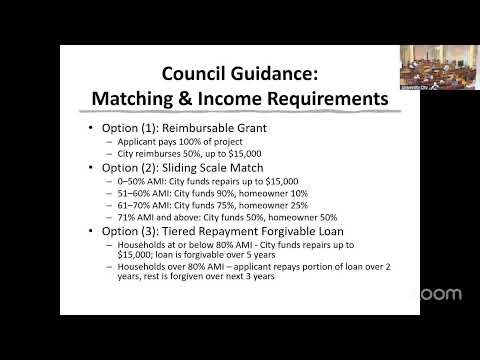
Matching and income options: staff presented four options and sought council guidance. The options included (1) a reimbursable model where residents pay upfront and are partially reimbursed (models considered: 50% or 100% reimbursement), (2) a sliding‑scale match based on HUD 2025 AMI (for example, 0–50% AMI = full city funding; 51–60% = 90/10; 61–70% = 75/25; 71%+ = 50/50), (3) a tiered forgivable loan focused on households at or below 80% AMI, and (4) no income requirement (first‑apply, first‑eligible). Several council members and staff said Option 2 best balances access and program sustainability while allowing staff to learn from the pilot.
Questions from council members focused on program safeguards and administration. Council member Clay asked whether a lien would be recorded for the five‑year forgivable grants; Franklin said yes, a five‑year forgivable lien would be recorded through St. Louis County and is designed to notify the city if a recipient stops meeting occupancy or other requirements. Council member McMahon suggested adding checks such as ensuring trash bills and taxes are current; staff said those and similar eligibility checks are part of the proposed requirements. Council members also pressed for clarity on how grant amounts were chosen; Franklin said the $10,000 and $15,000 figures derive from the task force recommendations and prior reports.
SHED, a nonprofit partner, offered to assist with outreach and contractor vetting. Joel Pugh of SHED told the council the organization plans to help with applications and can leverage county and private partners for contractor verification and additional funding. Franklin and Brooke Sharp, the city manager, said the city and SHED will coordinate marketing and application logistics and that staff would return to the council with final program documents and an application packet for approval (staff mentioned targeting an early‑April meeting but made no firm commitment).
Council members repeatedly emphasized the pilot nature of the effort: staff framed the programs as limited tests to refine eligibility, matching and administrative processes before broader rollout. Franklin estimated, if maximum grant amounts were used over the life of the TIF and other grants come online, the program framework could correspond to roughly 500 total grants across all related programs, but he cautioned many recipients would not use the full dollar caps and the figure is an estimate.
The city did not take a formal vote at the study session; council members indicated a consensus to move forward with a sliding‑scale match approach (Option 2) and asked staff to draft marketing materials, the application form and the full implementation agreement for formal council approval.
Next step: staff will finalize program materials, coordinate with SHED and return to the council with an approval item and recommendation for the pilot’s formal launch.