Get Full Government Meeting Transcripts, Videos, & Alerts Forever!
Get email alerts on the Public Pensions topic
No spam. Unsubscribe anytime.
Consultant: University City police and fire pension below 80% funding threshold; recommends city contribution, bargaining and ballot measure
Summary
A Baker Tilly consultant told the University City Council the police and fire pension is under the 80% funding threshold, recommends continued city contributions of roughly $500,000, negotiated employee contributions and a roughly $700,000 ballot measure, and suggested later merging into the statewide plan to cut administrative costs.
Andy Belknap, a consultant with Baker Tilly, told the University City City Council on Feb. 9 that the city’s police and fire pension fund is below the 80% funding threshold and faces “flashing yellow warning signs.” Belknap said the plan was ‘‘73–77%’’ funded in fiscal years 2024–25, is experiencing negative cash flow and that the shortfall has contributed to recruitment and retention challenges in the police department.
Why it matters: Missouri law and practices make an 80% funding level a common benchmark; being below 80% prevents the plan from adopting benefit enhancements such as cost-of-living adjustments, which Belknap noted have not been granted under this plan since 2007. If the fund were to fall below about 70%, he said, the city could run afoul of heightened state oversight.
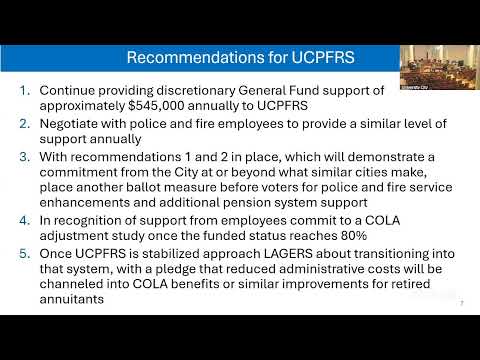
Belknap laid out a multi-step approach he said would improve solvency: “Number 1, continue to put… a little more than $500,000 in discretionary general fund support toward [the pension],” negotiate with police and fire employees to secure a contribution comparable to peers, then “go back to the ballot” seeking approximately $700,000 from voters to improve the funding level. He added that once the plan reaches healthier funding, the city should consider joining the statewide plan known in the presentation as “Loggers” to reduce administrative costs.
Council members pressed for specifics. Council member Brenner asked about the mechanics of migrating to the statewide plan; Belknap replied that migration is “not terribly complicated” but requires a healthy fund because the statewide plan will not take on an unhealthy pension. Mayor Crowe asked for comparative numbers on Loggers’ administrative costs and returns; Belknap said Loggers’ members average about 85% funded and that the statewide plan publishes annual statistics the city should review.
On the topic of employee retirement ages and recruitment, Belknap noted some nearby communities set normal retirement ages higher (he cited Brentwood, Ladue and Maplewood at 55) and that raising the retirement age is a possible lever but could affect recruitment advantages University City currently holds by allowing retirement at age 50.
Council member McMahon, noting prior liaison experience with the pension board, asked whether a one-time larger infusion (he estimated about $1.7 million) could “put us on more solid ground.” Belknap said a substantial infusion would help but cautioned the city is likely to face down years in market returns and recommended a mix of ongoing city funding and negotiated employee contributions to reduce the risk of slipping below 70%.
City Manager Sharp told the council that ongoing union negotiations present a timely opportunity to raise contribution discussions: “Especially since we are currently in negotiations with both police and fire unions… now is the prime opportunity to have those conversations.” Several council members volunteered to meet with staff and the city manager to explore options and next steps.
The council did not take a formal vote during the study session. Mayor Crowe closed the meeting by saying the session would stand adjourned until 6:30 p.m.
The consultant’s report and slides were presented as the basis for the discussion; council members requested follow-up figures on Loggers’ administrative costs and recent returns, and asked staff to gather additional comparative data before any formal decision or ballot placement.