Get Full Government Meeting Transcripts, Videos, & Alerts Forever!
Get email alerts on the Urban Forest Management topic
No spam. Unsubscribe anytime.
City staff outlines rewrite of Ellensburg’s tree code, proposes fees and construction protections
Summary
City of Ellensburg staff presented a complete repeal-and-replace of the city’s street-tree code into a new urban forestry chapter, proposing required tree-protection plans for construction, an in-lieu fee calculated per inch of trunk diameter, expanded arborist authority for administrative removals, and new public outreach materials funded by a $272,500 DNR grant.
Ellensburg City staff on Tuesday presented a proposed overhaul of the city’s tree regulations that would rename chapter 4.36 from the “street tree” code to an “urban forestry” chapter, add protections for trees during construction, and create a new in-lieu fee to fund tree replanting and maintenance.
Erin McGowan, water storm program coordinator, said the work is supported by a $272,500 grant from the DNR community and urban forestry program and combines five components: a city facilities and parks tree inventory, a street-tree inventory, updates to the tree ordinance, street-tree development standards, an urban forest management plan, and public outreach and education materials. “The grant was for $272,500 and it has made this urban forest management plan project possible,” McGowan said.
Why it matters: McGowan said the city’s inventories found 1,550 trees at city facilities and developed parks and just over 6,000 trees in the city right of way, and that the canopy is skewed toward younger specimens. The proposed code aims to protect mature trees, increase species diversity and make permitting and enforcement clearer so the city can conserve canopy benefits such as shade, stormwater mitigation, and improved air quality.
Major changes proposed include a clear purpose and value statement; new and revised definitions (including ‘public tree,’ ‘street tree’ and a ‘tree protection zone’); an explicit list of prohibited actions; a requirement for tree protection during construction supported by certified-arborist plans; and a transparent permitting process. McGowan said the change will let the city move technical procedures into development standards so updates do not always require ordinance amendments.
On fees and cost recovery, staff proposed establishing an urban forestry reinvestment account to receive in-lieu fees and pay for planting, establishment, maintenance and management of public and street trees. McGowan said the draft sets the in-lieu fee at $200 per inch of diameter at breast height (DBH); she gave an example that a 6-inch tree would carry a $1,200 in-lieu fee. The city currently requires a tree deposit ($400 for the first tree and $200 for each tree thereafter) that is returned if a property owner replants; the draft would allow billing the owner for the difference between the deposit and the in-lieu fee if they fail to replant.
The code would also expand administrative authority for the city arborist. McGowan said the arborist could approve removal without sending requests to council when a tree is hazardous and cannot be mitigated by pruning, is dead, is infected with an untreatable pathogen or pest, is on a prohibited-species list (examples cited: Siberian elms, black locusts), or is a volunteer tree under 4 inches DBH. “This will reduce unnecessary removals that we send your way,” she said.
Council members asked for clarifications on inventory mapping and construction impacts. McGowan said the public-facing tree map currently shows botanical and common names and can be expanded to indicate which trees are city-maintained and to include size metrics; she confirmed the street-tree inventory conducted in 2023 (report 2024) shows just over 6,000 trees in the public right of way, with only a fraction designated for city maintenance. When asked about construction-site compaction and repeated planting failures in new subdivisions, McGowan said stormwater rules govern concrete containment but that compaction and voluntary planting by developers make some issues difficult to require by code; she recommended certified-arborist assessments be used to document site conditions for homeowners’ associations.
McGowan summarized community engagement behind the effort: staff received 547 survey responses (the project target had been 100), held more than 350 in-person conversations at community events and achieved roughly 9,713 unique social-media views of their outreach. Survey responses indicated 91% of respondents support having more street trees and that many residents did not know that trees in the right of way not planted by the city are the adjacent property owner’s responsibility.
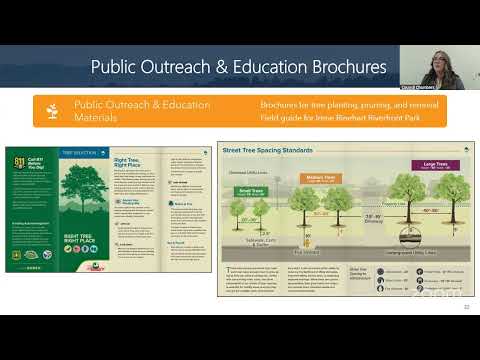
Next steps: McGowan said the urban forestry chapter is scheduled for first reading on July 20. Staff is completing an 85% draft of the urban forest management plan and will return the final draft for public comment; outreach materials, including bilingual (English/Spanish) planting and pruning guides and a park field guide with QR codes and a mobile app, are being prepared.
No formal council vote was recorded during the presentation; the item was presented as an informational update and scheduled for a first reading on the date cited by staff.