Get Full Government Meeting Transcripts, Videos, & Alerts Forever!
Get email alerts on the State Bonding Lead Lines topic
No spam. Unsubscribe anytime.
Coalition of Greater Minnesota Cities tells International Falls council bonding helped water projects but lead-line funding may fall short
Summary
Bradley Peterson of the Coalition of Greater Minnesota Cities briefed the council on the 2026 legislative session, saying the $1.24 billion bonding package included major water and wastewater funding but left lead-service-line replacement underfunded, and warned state zoning preemption efforts remain a recurring threat to local control.
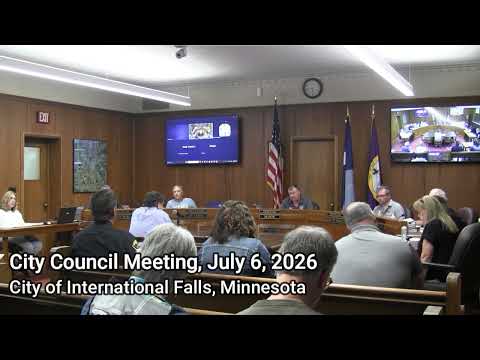
Bradley Peterson, who represents the Coalition of Greater Minnesota Cities through the Flaherty & Hood firm, told the International Falls City Council that the 2026 legislative session produced a $1.24 billion bonding package that directed substantial money to water and wastewater projects but likely left a funding gap for required lead-service-line replacements.
"Over $400 million went to water and wastewater programs and grants," Peterson said, noting $122 million of that was allocated to the Public Facilities Authority for grant and loan programs and local projects received additional funds. He said the total statewide bonding package was bipartisan and larger than the prior year’s local allotments.
Peterson said the state’s earlier 2023 allocation of $240 million to start lead-service-line removal identified 87,000 known lead lines and left some 200,000 to be identified. He told the council the Department of Health estimated total replacement costs of roughly $1.5 billion statewide and that the bonding actions so far—$1.515 million (sic in presentation)—may be insufficient to sustain momentum into 2027 and 2028.
"We treated lead lines as a separate discussion," Peterson said. "Our initial ask was $250 million because we needed enough to support a 2027 construction season. I’m concerned we may lose momentum." He added that local projects have seen replacement costs vary between $12,000 and $15,000 per household depending on site conditions.
Peterson also described ongoing efforts to oppose state-level zoning and development preemption that would restrict local land-use authority—measures he said repeatedly surfaced during the session but failed to advance this year. He said CGMC will continue to engage candidates and legislators ahead of the 2027 session and encouraged local officials to join the organization’s events.
Why it matters: Peterson framed the bonding bill as a positive for local infrastructure funding but flagged lead-line replacement as an area where more, stable revenue may be needed. His update provided local context for International Falls’ pending water project and the city’s relationship with the PFA and state funding processes.
What’s next: Peterson invited councilors and staff to CGMC events and legislative action day in Saint Paul in February 2027 to advocate for continued local priorities.