Get Full Government Meeting Transcripts, Videos, & Alerts Forever!
Get email alerts on the Property Tax Reform topic
No spam. Unsubscribe anytime.
Property tax plans discussed as Broward appraiser warns of tens of millions in local losses
Summary
Broward County property appraiser Marty Kerr outlined ways proposed state-level property tax changes could cut Hollywood’s revenue by tens of millions, while commissioners pressed for clarity about technical details such as insurance definitions, portability and implementing legislation.
Marty Kerr, Broward County property appraiser, told the City of Hollywood commission on Feb. 23 that several proposals under consideration in Tallahassee could sharply reduce local property-tax revenue and still require implementing legislation to define how relief would work.
Kerr said a broad repeal of property taxes would amount to “about a $55 to a $60,000,000,000 loss for the people of Florida,” and that narrower measures now being discussed—such as limiting relief to homesteaded properties—would still hit local governments. He presented modeled scenarios showing Broward County could lose roughly $624 million (about 34.6%) and Hollywood could lose about $57.8 million (about 26.6%) under one proposal he labeled as HJR 203.
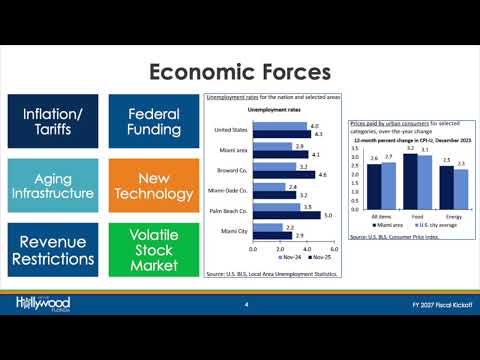
Why it matters: property taxes account for a large share of the city’s general fund. Reischbach, the city’s assistant manager, had earlier told the commission that property taxes represent about 46% of Hollywood’s general fund and that public safety consumes roughly two-thirds of those dollars, a budget structure Kerr said would complicate hold-harmless language for police and fire.
Kerr walked the commission through several specific ballot concepts: a broad homestead repeal that would preserve only the school portion of the tax bill; a senior-only version that would exempt homesteaded owners over 65; a homeowners-insurance-linked exemption that would add a $200,000 homestead exemption for owners with “multi-peril” homeowner policies; portability changes that would remove the $500,000 cap on transferred Save Our Homes value; and a proposal to shift to three-year reassessments for both homestead and non-homestead properties. For each, he provided countywide and Hollywood-specific estimates of median homeowner savings and government revenue loss.
Commissioners focused questions on technical details that the constitutional language and potential implementing statutes would need to resolve. Commissioner (speaker 6) asked whether the insurance-linked exemption would require wind coverage; Kerr replied, “They haven't defined multi peril insurance, have they?” and said that an implementing bill would be expected to specify the definition and effective rules. On portability, Kerr said it could spur moves and therefore increase take-up, but noted that “it's very hard to quantify it, without seeing the future.”
Kerr repeatedly emphasized uncertainty: implementing bills—statutory measures that would tell governments how to administer an amendment—had not been passed, and effective dates vary. He warned commissioners that, even if a change takes effect in 2027, many fiscal consequences would appear in FY2028 and later.
The commission did not take any formal action. Staff said it will monitor Tallahassee developments and fold likely scenarios into FY2027 planning and FY2028 forecasting; Reischbach told the commission staff will present operating and capital workshops in June and bring proposed millage and public-hearing dates in July and September.
Ending: Commissioners asked Kerr to return if a final ballot measure emerges so staff and the public can see the specific fiscal arithmetic tied to the final language.