Get Full Government Meeting Transcripts, Videos, & Alerts Forever!
Get email alerts on the Environmental Guidelines topic
No spam. Unsubscribe anytime.
Sustainability advisory committee asks council to fund consultant, adopt environmental guidelines for land development
Summary
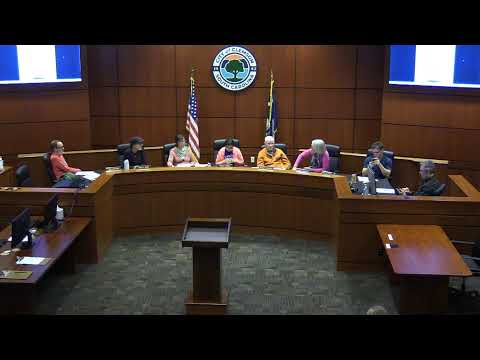
Clemson's Sustainability Advisory Committee voted to ask city council to fund a consultant and to incorporate a set of environmental guidelines into the city's upcoming Unified Development Ordinance, with members stressing the guidelines should also protect public health.
The Clemson Sustainability Advisory Committee voted April 8 to recommend that city council "equip planners with the necessary resources to implement environmental guidelines for land development in Clemson," asking that the attached draft be considered as the reference document.
The motion, offered by speaker 5 (who identified herself in the meeting transcript as Eunice Lehmanacher), urges the council to include funding in the fiscal-year budget for a consultant to help prepare the Unified Development Ordinance (UDO). Committee members noted city staff already plan to request a consultant in the FY July 2026'June 2027 budget to produce a consolidated UDO and said the committee's recommendations could be incorporated during that process. "The city staff were very enthusiastic when they looked at this," one committee member said during discussion.
Discussion focused on whether the draft should pair environmental language with explicit public-health protections and whether it should rely on incentives or include penalties. A member suggested amending the motion's intent sentence to read that the city should "preserve and protect natural resources for future generations and protect the public health," and that friendly edits to guiding principles (for example, using "or" rather than "and" in one tests) would avoid inadvertently blocking projects that meet one but not all criteria.
The committee also discussed a point-based approach for developers, analogous to existing tree-preservation rules, where projects would earn points across categories (trees, water, energy and transportation) and could receive incentives or face penalties if minimums were not met. The draft appended to the motion clarifies which items are existing code (in bold) and which are committee suggestions.
The chair called a voice vote and the motion passed; the transcript records a unanimous voice vote but does not include a roll-call tally. The committee directed staff to present the motion and the attached draft to city council when the consultant and UDO timeline make that the appropriate next step.
What happens next: committee members said they will continue to refine intent statements and measurement criteria for items listed on pages 2'4 of the draft, and to provide that material to staff and the consultant once hired. The committee also offered to supply council with the revised draft and supporting examples from other cities.