Get Full Government Meeting Transcripts, Videos, & Alerts Forever!
Get email alerts on the Parole Language Review topic
No spam. Unsubscribe anytime.
Panel questions victim‑privacy and guideline references in parole bill language review
Summary
The Joint Standing Committee on the Judiciary conducted a preliminary language review of the parole bill (minority amendment A), asked whether mandatory discovery should exclude victim-identifying information, and debated how parole guidelines and Administrative Procedures Act language should be incorporated in statute.
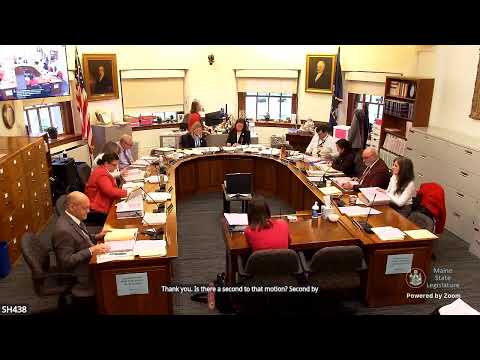
The Joint Standing Committee on the Judiciary on July 7 conducted a preliminary language review of the parole bill and its three minority amendments, focusing early discussion on how the bill treats victim information and whether the committee's parole guidelines should be explicitly incorporated.
Eli Murphy of the Office of Policy and Legal Analysis walked members through minority amendment A and flagged several drafting questions, including whether "no later than 30 days before the date of the hearing" mandatory discovery should carry an exception for victim information. Murphy referenced existing confidentiality language in Title 17‑A §2108 and suggested either adding that text into the bill or cross‑referencing it. "My question is, should there be an exception for victim information?" Murphy asked the committee during the review.
Members responded that the intent is to keep victim information confidential. A committee member noted that recent statutes passed during the session treated similar material as a unit and supported including those provisions in the bill's confidentiality treatment. Murphy also raised whether the bill should explicitly reference the committee's parole guidelines (58‑26) or rely on the Administrative Procedures Act; members observed that 58‑26 requires application of those guidelines for parole hearings and felt it may be acceptable to rely on the APA where appropriate.
Murphy further asked whether the bill's list of offense chapters should include certain commercial exploitation offenses that currently sit in a different part of statute. Members agreed it would be consistent with recent legislative practice to include those offenses in the broader category under discussion.
The committee directed staff to make drafting edits to mark sensitive items as confidential where intended and to reconcile cross‑references to existing statutory schemes. No formal vote was taken on the bill during the session; Murphy said he would circulate revised language and seek comment by 3 p.m. the following day.
The committee adjourned after completing the in‑person portion of the language review and scheduling remaining final edits to be handled by email.