Get Full Government Meeting Transcripts, Videos, & Alerts Forever!
Get email alerts on the Sewer Rates topic
No spam. Unsubscribe anytime.
Port Orchard committee reviews adopted sewer-rate changes, shift to ERU billing
Summary
The Port Orchard Utilities Committee reviewed the council'adopted sewer rate methodology on March 10, including a move to ERU-based billing and a 4.5% annual adjustment adopted to fund operations and capital needs; staff will circulate the slides and continue outreach.
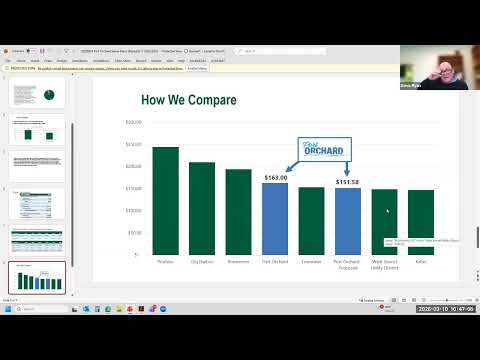
On March 10, the Port Orchard Utilities Committee reviewed the sewer-rate methodology City Council adopted that moves the city to an ERU (equivalent residential unit) billing structure and implements a 4.5% annual adjustment to sewer rates, Public Works Director Dennis Ryan told the committee.
Ryan said the city contracted FCS Group to analyze sewer rates for 2025''2030 and found that flat rates since 2020 had left sewer revenues behind inflation and insufficient to cover rising operations, maintenance and planned capital work. "The study found that the city needs to increase our sewer revenue, which was decided at 4 and a half percent when council did vote for this," Ryan said.
The consultant'staff cost-of-service analysis showed about 94% of customer connections are residential and roughly 6% are nonresidential, yet nonresidential accounts represent about 20% of system flows. To address that imbalance, the adopted approach consolidates roughly 21 customer classes into ERUs. "ERU is equivalent residential unit. So a single family home is 1 ERU," Ryan said, and some businesses are assigned multiple ERUs to reflect higher sewer output.
Ryan reported there are approximately 5,690 residential ERUs in the city and described the adopted per-ERU charges presented to the committee. He said the new structure produced a residential bill that decreased in the first year (Jan. 1 effective date) and then increases by the adopted percentage in subsequent years, while many nonresidential accounts saw a larger first-year rise as the structure rebalanced cost responsibility.
Council Member Jay Rosapepe and Council Member Heidi Benton emphasized the equity rationale: the change consolidated a complex, 21-class rate schedule into a simpler, more transparent ERU-based system and is intended to more fairly align charges with impacts on the sewer system. Rosapepe said the approved five-year outlook will fund two additional staff positions to support sewer projects.
Ryan outlined the public process: staff presented initial work in June, held a work study July 16, a public hearing Sept. 23 and the Council adopted the rate methodology on Oct. 14; the changes were advertised in local newspapers, on social media and by notice in utility billing. Ryan said he will circulate slides and materials to council members for outreach and reference.
Staff also noted stormwater rate changes adopted mid-2024 and adjusted again in 2025; Ryan reminded the committee that stormwater increases are posted in billing language and that rate tracking can be hard for some customers.
The committee did not take new formal action at the March 10 meeting; members asked staff to provide the presentation materials and outreach language. Ryan said he would forward the slides and remain available to answer questions after the meeting.