Get Full Government Meeting Transcripts, Videos, & Alerts Forever!
Get email alerts on the Facilities topic
No spam. Unsubscribe anytime.
Consultants warn aging systems, present repair vs. new middle‑school cost comparison to Dover board
Summary
Consultants told the Dover Area School District board that aging chillers, leaking piping and stormwater problems push key repairs into the near term; they presented ranked work lists and compared $55–62 million of system‑upgrade work to a $70–91 million new middle‑school option, while estimating roughly $200,000 a year in energy savings for a new building.
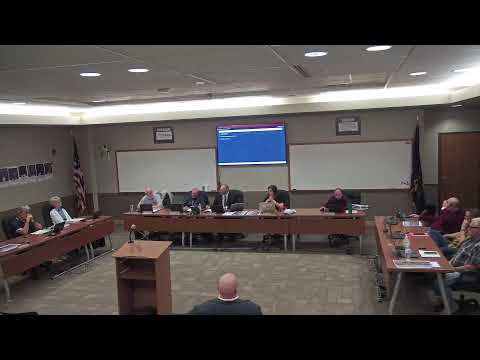
Consultants from EI Associates, KNW Engineers and Moore Engineering presented a districtwide facilities assessment to the Dover Area School District board and laid out two paths: prioritized repairs across existing schools, or construction of a new middle school.
Adam Kerr of EI Associates said the firm performed on‑site reviews of building envelopes, systems and site circulation and delivered a ranked list of recommended improvements. KNW civil engineer Carolyn Du Bois told the board that recurring site issues included pavement deterioration and stormwater ponding, and she recommended selective repaving, inlet repairs and adjustments to parent‑drop‑off circulation to reduce queuing and safety risks.
Ken Kaufman of Moore Engineering described system‑level risks. He warned that several chillers in elementary and middle‑school buildings are about 24–28 years old and run on R‑22 refrigerant, which is phased out and increasingly expensive to service. "The chiller plants are…28 years old," Kaufman said, noting replacement parts and recovered refrigerant are scarce and costly. He also flagged moisture damage, aging low‑voltage systems and sanitary lines under slabs that would require invasive repairs.
The consultants presented an opinion of probable costs and two comparative scenarios. Addressing Rank‑1 and Rank‑2 items across the existing facilities, they estimated total project costs in the range of roughly $55 million to $62 million (hard construction plus soft costs and escalation assumptions). A conceptual new middle‑school building — about 125,000 square feet in a partial two‑story layout — carried a higher cost estimate, roughly $70 million to $91 million depending on scope and an 8% escalation allowance for a longer schedule.
Kaufman also compared energy performance. He reported the existing middle school modeled an Energy Star score near 34 and annual energy costs around $320,000; his block model for a new facility produced an Energy Star score near 80 with an estimated annual cost of about $110,000, implying roughly $200,000 annual energy savings under current assumptions.
Board members pressed consultants on assumptions and next steps. The consultants said the 10% enrollment buffer used to size the conceptual new school was not based on a demographic study and recommended performing one before making long‑term decisions. They also advised the board that many system components would likely be extended about 20 years with full system replacements but that some items (for example a failing chiller or underground sanitary piping) represent near‑term operational risk that could force emergency action.
The board thanked consultants for the detailed analysis and directed the Facilities Committee and administration to take the ranked recommendations under advisement, prioritize urgent system replacements, and return with more refined cost and phasing options for budgeting and potential grant pursuit.