Get Full Government Meeting Transcripts, Videos, & Alerts Forever!
Get email alerts on the Police Staffing topic
No spam. Unsubscribe anytime.
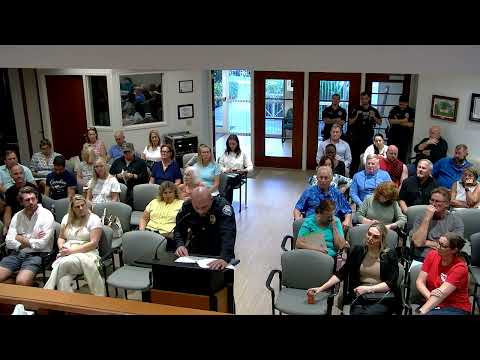
Residents and officers press Lake Clarke Shores council over police pay and retention
Summary
Dozens of residents and several officers urged the council to address pay and retention problems in the Lake Clarke Shores Police Department, warning the force is at a "breaking point" and urging either better funding or consideration of contracting with the Palm Beach County Sheriff's Office.
Dozens of residents and on-duty officers pressed the Town of Lake Clarke Shores council on March 9, urging faster action on police officer pay and benefits amid staffing shortages.
Corporal Dominguez, who identified himself during public comment, told the council the department is "at a breaking point," saying officers feel "undervalued" and citing long-term turnover. He said "55 full time and part time officers have left the Lake Clark Shores Police Department" over the last decade and described recent resignations and a current criminal investigation in the department. "When officers leave because they cannot afford to stay here, it is not just a staffing issue. It becomes a public safety issue for every resident," he said.
The corporal criticized a $4,000 raise proposal as insufficient and said retirement and take-home vehicle policies leave patrol officers at a competitive disadvantage compared with neighboring agencies. "A $4,000 increase does not close that gap," he said, arguing the town must address wages, retirement and standard benefits together.
Residents reinforced that message with several personal accounts. Alex O'Hara described a home-invasion scare and praised the rapid response by Lake Clarke Shores officers; Steven Quattrochi, a law enforcement professional, credited officers with sustained support after a family crash; Tom DiPolito, also an officer, warned that retention problems could make contracting with the sheriff's office a likely but unwelcome alternative.
Others raised sharply different concerns: Louise Brandenburg and Clement Brandenburg recounted long-running disputes with the department and alleged mishandling of an elderly relative's case and selective enforcement; Louise Brandenburg said state investigators eventually cleared her family but that the ordeal left lasting harm.
Council members repeatedly told speakers they support the department but cautioned that specific negotiation details cannot be discussed publicly during active collective bargaining. One council member said staff "are currently engaged in good faith negotiations and are committed to reaching a fair ... agreement," adding that discussing financial specifics in open session could affect bargaining.
In the meeting's status reports, police leadership said the department is down from about 11 sworn officers to six available for road patrol and that software/CAD problems are forcing officers to return to the station to complete reports, reducing patrol time. Chiefs also asked residents to call 911 for suspicious activity to ensure timely dispatch.
The council did not make a public policy decision or adopt a contract at the meeting. Officials said negotiations will continue and pledged to work toward a resolution, while residents asked to be kept informed of options—particularly what switching to the county sheriff would mean for service levels and taxes.
The town presented Corporal Dominguez with a life-saving citation at the meeting for a January 12 incident in which he administered CPR and the patient later recovered.