Get Full Government Meeting Transcripts, Videos, & Alerts Forever!
Get email alerts on the School Finance topic
No spam. Unsubscribe anytime.
Kyrene staff outline FY27 revenue assumptions as enrollment decline trims state funding
Summary
Associate Superintendent Chris Herman told the board that falling kindergarten cohorts and other demographic shifts will reduce state M&O funding for FY27, and presented detailed assumptions — including a $109.7 million M&O estimate and a roughly $112.0 million general fund projection — while urging the board that legislative changes could alter those numbers.
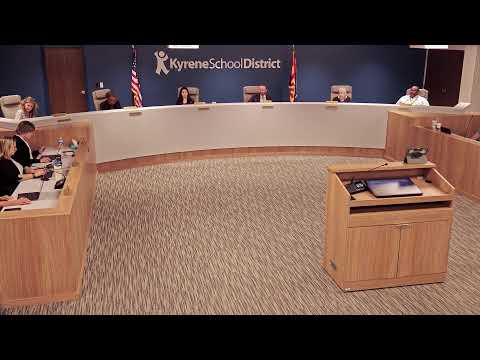
Associate Superintendent Chris Herman told the Kyrene Elementary District Governing Board on April 7 that the district’s preliminary fiscal year 2026–27 maintenance and operations (M&O) revenue estimate is $109,700,000 and that total general-fund revenue is projected to be just over $112,000,000. He said the district’s M&O calculation rests on three components: the base support level (state per-pupil funding), the revenue control limit (which adds transportation funding), and additional sources such as district additional assistance (DAA) and voter-approved overrides.
Herman emphasized enrollment as the primary driver for the budget outlook. He noted that demographer data show falling birth rates and reduced household turnover in Kyrene’s boundaries, producing smaller incoming kindergarten cohorts relative to larger outgoing 8th-grade cohorts. "This information simply means that there are fewer children born each year across Maricopa County and within our own boundaries," he said, and he walked the board through the weighted average daily membership assumptions that feed the base support calculation.
Herman broke down assumptions used in his FY27 projection: a statutory maximum inflation increase of 2% that would raise the per-weighted-ADM amount to $5,215.53; a teacher experience index (TEI) of about 1.02, providing roughly $440,000 in additional funding; and an overall net weighted‑ADM decline that results in an estimated $2.3 million reduction in base funding versus last year. He pointed out that some state-level items (including possible one-time Prop 1‑2‑3 disbursements or other legislative changes) remain unsettled and would be incorporated if enacted before the district adopts a final budget.
Board members pressed for practical context. Member Davis asked whether teacher pay comes from M&O; Herman replied that roughly 90–95% of teacher salaries are funded from M&O but that some targeted funds (Proposition 301, Fund 10) can also supplement pay or support performance pay. When asked about DAA differences for charters, Herman said statutory differences explain the disparity and that Kyrene assumed no increase to DAA per ADM for FY27 ($549.45 per ADM in the current model).
Herman also reviewed smaller general-fund lines the district tracks, including Medicaid reimbursements (projected modestly higher for FY27 to $1.4M) and school-plant lease income from property leased off I‑10. He cautioned the board that one-time state funding in past years complicates historical comparisons.
The presentation concluded with a reminder that assumptions will be updated as the legislature finalizes the state budget: "If any of those changes happen, then those revenue estimates that we're providing today, we'll update them and we'll give the board an idea of what's changed since today," Herman said. The board will continue study sessions through May and June ahead of formal budget adoption.
What’s next: district finance staff will refine revenue and expenditure projections in subsequent study sessions and present a recommended budget for the board vote in June.