Get Full Government Meeting Transcripts, Videos, & Alerts Forever!
Get email alerts on the Housing Policy topic
No spam. Unsubscribe anytime.
Spokane housing subcommittee refines housing chapter language, debates mandates vs. incentives for affordable units
Summary
At a Plan Commission housing subcommittee meeting, staff and commissioners debated where to place several policies in the draft housing chapter, whether affordable-unit requirements should be mandatory or incentivized, and how to square redevelopment with displacement risk; staff will revise language and return with clarifications and technical appendices.
Presenter opened the subcommittee meeting and framed the housing chapter's purpose as identifying current and future housing needs and outlining strategies for the next 20 years, including increasing supply, retaining existing housing, addressing racially disparate impacts and reducing displacement risk. Presenter said the chapter contains more new goals and policies than prior versions because it incorporates outcomes from previous engagement and planning work.
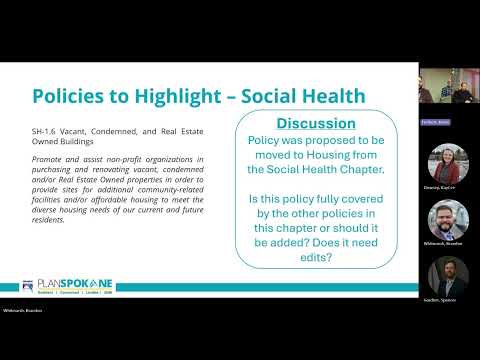
Committee members questioned whether specific items belong in the housing chapter or should be cross-referenced with economic development. Presenter asked about policy 1.3's placement; Committee member B said it makes sense to keep the concept in housing while adding a cross-reference to economic development to avoid duplication.
A major thread of the discussion concerned whether the draft should call for mandatory affordable-unit set-asides in new development or prioritize incentives. Committee member A said incentives are preferable, warning that blanket requirements could raise overall housing costs. Presenter said the lower-level policy currently reads as an exploration of options that could include a requirement but also possible incentives and offsets; staff and several members favored prioritizing incentives and flexibility in implementation.
Committee members also urged clearer definitions of "affordable." Committee member B recommended the chapter clarify whether references map to AMI bands (for example, 0'to'80 percent AMI) and to distinguish between "lower income" and "low income" uses of the term. Staff said technical analyses required by state guidance (referenced in the meeting as "HP 12 20") and the land capacity analysis (LCA) will be provided as appendices and will show whether shortfalls exist and what incentives or grants may be needed.
Panelists debated the tension between retaining existing, naturally affordable housing and pursuing redevelopment that increases supply. Committee members asked that the plan acknowledge trade-offs and decision-making approaches rather than implying the priorities are absolute. Several members suggested language that flags the tension and sets expectations for future, site-level decisions.
Other policy topics discussed included: a proposed policy supporting nonprofit reuse of vacant property for affordable housing (members favored incorporating the concept into goal 4 or adding cross-references); protecting manufactured and mobile homes as naturally affordable housing while recognizing safety and zoning constraints; promoting aging-in-place through accessible design and possible incentives; and a request to explicitly support community land bank efforts and to explore patient capital and other financing mechanisms.
Short-term rentals were discussed briefly. Several members said local registration and survey data indicate limited current impact but recommended continuing to monitor the market and keep policy language flexible so the city can respond if conditions change.
On displacement language, members debated phrasing such as "mitigate" versus "reduce" displacement risk; staff noted statutory and state-plan checklists (HP 12 20) require displacement risk and racially disparate-impact analysis, which constrains local phrasing and content. Committee members asked that the plan make clear how mandatory elements required by state law fit with local policy choices.
Members asked how the comprehensive plan interfaces with code enforcement and implementation. Staff described an upcoming monitoring/implementation functional chapter and said technical follow-up (implementation plans, monitoring matrices, and the EIS comment/response process) will provide details on feasibility, enforcement, and funding, and that those materials will return to the commission for further review.
No formal vote or ordinance was recorded at the meeting. Staff said they would review the placement and wording of the discussed policies, prepare technical appendices (including LCA and EIS responses), and return the refined material to the full commission or schedule further subcommittee discussions as needed.
The subcommittee thanked staff for the work and closed the session, noting that some items may be "bike-racked" for later consideration by the full Plan Commission.