Get Full Government Meeting Transcripts, Videos, & Alerts Forever!
Get email alerts on the Lung Cancer Screening topic
No spam. Unsubscribe anytime.
Albert Einstein medical students promote lung‑cancer screening, explain who qualifies and how to get referred
Summary
Medical students from Albert Einstein’s chapter of the American Lung Cancer Screening Initiative presented screening eligibility and referral resources to Community Board 11 on March 10, urging neighbors to use a QR eligibility form that can trigger a referral into Montefiore’s screening program.
At the March 10 meeting of Bronx Community Board 11’s Health & Social Services Committee, medical students representing the American Lung Cancer Screening Initiative (ALCSI) urged residents to learn whether they qualify for low‑dose CT lung‑cancer screening and explained how the referral process works.
Summer, vice president of ALCSI and a first‑year medical student at Albert Einstein College of Medicine, told the committee the chapter’s mission is to increase access to early detection in Bronx communities and to reduce stigma that discourages people from seeking screening. "We want many people to see this as a helpful preventative tool just like getting a colonoscopy or a mammogram," she said.
Presenter Julie Mihalak summarized national trends, saying current estimates for 2026 indicate more than 230,000 new lung‑cancer cases and roughly 125,000 deaths, and noted that smoking remains the leading risk factor. Elise Wallen Friedman, co‑president of the local ALCSI chapter, explained the program’s eligibility rules: people aged 50–80 who are current smokers or who quit within the last 15 years and who have a 20‑pack‑year smoking history are typically eligible for low‑dose CT screening. "Screening is for asymptomatic individuals only," she added, clarifying that someone with a new cough or chest pain should receive a diagnostic workup rather than a screening exam.
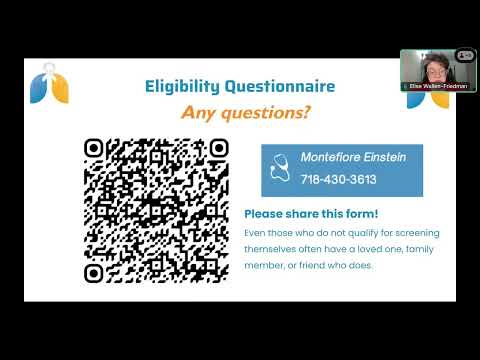
On logistics, presenters said the Montefiore‑Einstein Comprehensive Cancer Center performs the low‑dose CT scans locally and that ALCSI can help arrange referrals. ALCSI provided a QR code that links to an eligibility questionnaire; Elise said that if the form indicates eligibility, the chapter will contact the Montefiore physician in charge and help set up the referral. She also told the committee that insurance commonly covers the screening when performed through an in‑network program, and that uninsured patients should contact Montefiore social work or billing to explore options.
Committee members asked whether providers outside Montefiore — for example, Jacobi Medical Center — can refer patients. Presenters said they would follow up by email to clarify cross‑system referral rules. They also answered questions about how clinicians distinguish long‑term respiratory conditions such as asthma from possible cancer, noting that diagnostic steps (chest X‑ray, pulmonary function testing, pulmonology consult and biopsy when indicated) guide care for symptomatic patients.
Presenters committed to email the QR code and eligibility materials to the board for distribution and agreed to staff a table at the board’s upcoming late‑April health fair. The committee expressed interest in promoting the screening hotline and the eligibility questionnaire to Bronx residents.