Get Full Government Meeting Transcripts, Videos, & Alerts Forever!
Get email alerts on the State Infrastructure topic
No spam. Unsubscribe anytime.
State Officials Outline Bond Priorities and a Plan to Move Data Center Out of Pfizer Lease
Summary
DAS and OPM briefed the subcommittee on multiple bonding requests, including a $20M fleet garage relocation, $50M added school‑building reimbursements, and $32M to support state data‑center equipment and migration as the Pfizer lease ends; OPM described DRIP (district repair and improvement program) rollout and emphasized constraints from the bond allocation cap.
Department of Administrative Services Commissioner Michelle Gilman told the bonding subcommittee DAS manages a large portfolio of projects and seeks targeted new authorizations: $20,000,000 to locate a replacement for the Weathersfield fleet garage and $50,000,000 in additional authorization to ensure timely payment of school building reimbursement grants (bringing the FY27 school building authorization to $600,000,000). Gilman also requested $32,000,000 to fund data‑center equipment and migration costs as the current Pfizer colocation lease approaches expiration in 2029.
Mark Raymond, the state chief information officer, explained DAS and OPM issued an RFP for colocation services and are evaluating responses rather than building an in‑house hyperscale center. He said state needs are modest by hyperscaler standards (roughly 750 kilowatts rather than multi‑megawatt hyperscale deployments) and that the requested $32 million is primarily for specialized IT equipment (servers, storage, UPS, networking) and costs to migrate state fiber and services.
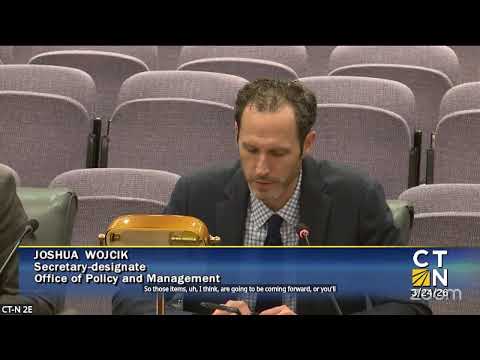
Office of Policy and Management Secretary reviewed statewide bond policy implications: the state has been approaching a roughly 11% share of the general budget for debt service and must balance new authorizations against that cap. Secretary and undersecretaries outlined DRIP (district repair and improvement program) rollout logistics — annual certifications will be required and OPM planned initial payments after April 15 certifications — and said OPM will monitor unallocated authorizations such as STEEP and SON of TAR to ensure funds move to shovel‑ready projects.
Committee members questioned the cost of repurposing existing data‑center facilities versus colocation and were told rehabilitation of an existing center would likely add $20–40 million in one‑time costs to reach the state's required standards. DAS and OPM emphasized readiness and the cost escalation risk when projects are delayed.
Next steps: DAS and OPM will continue RFP evaluation, work with Pfizer on lease timing, and coordinate with the subcommittee on the proposed authorizations and upcoming bond commissions.