Get Full Government Meeting Transcripts, Videos, & Alerts Forever!
Get email alerts on the Telecom Infrastructure topic
No spam. Unsubscribe anytime.
Developer proposes cell towers on Arnold property with revenue share; staff to review master marketing agreement
Summary
A tower developer presenting as Virta (formerly Arcadia) proposed leasing small city parcels to build up to five towers at no upfront cost to the city, offering a 30% revenue share; staff will circulate a draft master marketing agreement for legal review and return to council.
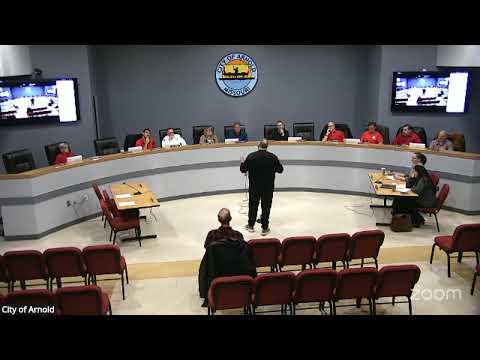
Billy Patterson, a business-development representative for a tower developer now operating as Virta, presented a pitch to the Arnold City Council at a work session for building cell towers on city-owned land.
Patterson described a two-step approach: sign a five-year master marketing agreement allowing the company to market city properties to wireless carriers (no commitment to build), then, if carrier interest emerges, present individual site lease agreements for council approval. "It's a no-cost, no-risk proposition to enter into the master marketing agreement," Patterson said.
The proposal would ground-lease small parcels (about 50 by 50 feet), with Virta covering all construction and permitting costs. Patterson said the company proposes sharing 30% of tenant (carrier) rent with the city. Using conservative assumptions (two tenants modeled per tower), he said a single tower would generate about $14,400 to the city in the first modeled year and that five towers at 50% capacity could model to just under $3 million in total revenue projection over the modeled period. Patterson also said the company can offer various deal structures, including a prepayment option (he cited a $94,000 10-year prepayment example) that would suspend periodic rent for a defined term.
Council questions focused on site specifics, aesthetics and health concerns. Bill Moritz asked Patterson to show the five proposed sites and the map; Patterson said the initial list is preliminary and that there are many potentially viable parcels. Residents and council members raised aesthetics and asked whether disguised or "stealth" designs (flagpole, clock, tree, etc.) were available; Patterson said those options exist but can increase costs and slightly affect economics while not materially affecting signal efficacy. He also pointed council members to public-health materials on his company's website and professional bodies (he referenced the AMA) to address health questions.
From a legal and procedural standpoint, the city attorney/staff said they would need to review the draft master marketing agreement and site lease exhibit carefully and ensure full disclosure of tenant lease terms and city obligations before any site lease is signed. Staff (speaker 11) said they would coordinate with Patterson to deliver a draft master marketing agreement and bring it back to council at a future meeting (likely in January depending on agenda timing).
Quotation highlights: "We share 30% of that revenue with you all at the city," Patterson said of the modeled rent split. "You can still say, no," Patterson said of the later site-approval step, describing the MMA as nonbinding on individual site decisions.
Council direction and next steps: Council expressed interest in having staff and legal counsel review the draft MMA and site-lease exhibits and asked staff to bring the documents forward for consideration. No vote or contract was approved at the work session.
Notes on sourcing and limits: Revenue projections and site viability were presented by the developer and modeled conservatively; they depend on carrier interest and final lease terms. Health and safety assertions referenced by the presenter were not examined at the meeting; the city attorney recommended a full legal review before any commitment.