Get Full Government Meeting Transcripts, Videos, & Alerts Forever!
Get email alerts on the Substance Use topic
No spam. Unsubscribe anytime.
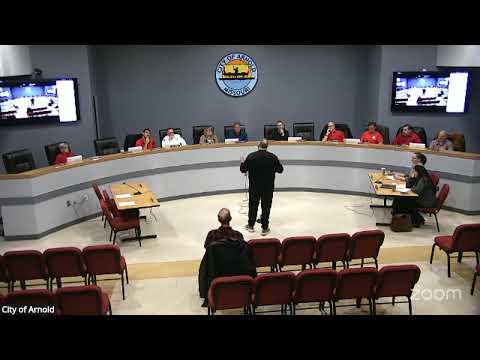
Art Dean Alopis of ACPD urges Arnold officials to back more local long-term addiction treatment
Summary
At an Arnold work session Art Dean Alopis of nonprofit ACPD described losing his son to overdose, said his group has placed "a little over 6,000 people" into recovery with an "81 percent success rate," and asked city leaders to support local treatment and transitional housing.
Art Dean Alopis of ACPD told the Arnold City Council at a work session that he lost his son to substance use in 2016 and has since built a volunteer-run nonprofit to help people enter long-term treatment.
"Never in 1000000 years, I thought I'd be in front of city hall," Alopis said, describing his son's death and his decision to start ACPD. He said ACPD, a 501(c)(3), has sent "a little over 6,000 people" into recovery and cited an "81 percent success rate" for the organization's placements, which he attributed to long-term programs and intensive aftercare.
Why it matters: Alopis framed the presentation as local evidence of a countywide treatment gap, saying many callers in Arnold and Jefferson County cannot access beds, that his organization receives hundreds of calls weekly and responds to dozens of overdoses a month, and that neighborhoods are experiencing fatal and nonfatal overdoses. He said ACPD has placed people as young as 15 and as old as 68 and called for community support to establish transitional housing or a long-term treatment facility in Arnold or nearby Jefferson County.
Alopis recounted efforts to place clients in programs out of state and to run a transitional house in Festus (Austin's Transitional Living, "ATL"). He described the program's regimen: multi-week residential stays, five meetings per week, employment expectations, community service and structured aftercare. He said the organization's model emphasizes longer stays than typical 30-day programs and active post-treatment follow-up.
During Q&A, council members asked what ACPD does differently than other providers and about funding. Alopis said much of ACPD's work depends on donations and volunteers; he said many treatment centers near St. Louis charge $15,000'$25,000 per month and that ACPD raises scholarship funding and partners with owners of long-term facilities to place indigent clients for much lower out-of-pocket cost. He also said his group relies on relationships with local judges and prosecutors to identify people suitable for treatment.
Alopis also gave local counts and trends as observed by his organization: he said his team logged 157 overdoses and 55 deaths among the people they had been working with since June, and that his group fields calls from about 4:15 a.m. until after midnight most days. Those figures were presented as Alopis's operational totals and were not independently verified during the meeting.
Council response and next steps: Council members thanked Alopis for the presentation and discussed the potential for city collaboration. Alopis explicitly asked the city to consider helping identify property or other resources for a transitional or treatment facility; council members expressed sympathy and interest in reviewing how the city might support local recovery infrastructure. No formal motion or funding decision was taken at the work session.
The council's next steps are limited to further conversation and staff follow'up; Alopis left his contact information and offered to work with first responders and staff to connect individuals to services.
Quotation highlights: "We have an 81 percent success rate, which is unheard of," Alopis said of ACPD's outcomes. "There's enough fentanyl in The United States to kill everybody 7 times over," Alopis said, describing the drug mix his team encounters.
Notes on sourcing and limitations: All quoted statements and operational figures in this article come from Alopis's presentation to the work session. The council did not vote on an item connected to ACPD during the meeting. Financial figures about treatment costs and ACPD's success rates were presented by Alopis and were not corroborated by independent documents during the session.