Get Full Government Meeting Transcripts, Videos, & Alerts Forever!
Get email alerts on the County Budget topic
No spam. Unsubscribe anytime.
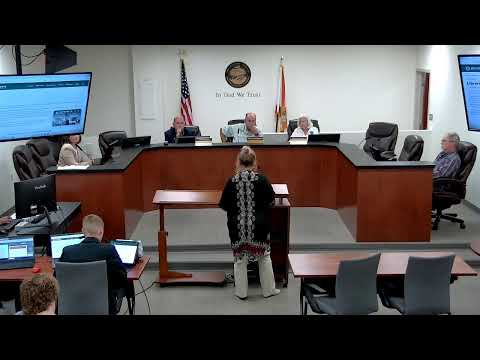
Walton County budget workshop: rollback millage, $4M in cuts and a contentious hiring-freeze debate
Summary
At a Walton County budget workshop staff outlined a proposed $346.7 million FY27 budget and said adopting the rollback millage (3.4347) would require about $4 million in cuts; commissioners debated a hiring freeze, audits and whether to trim capital or operating services.
County staff presented a preliminary fiscal-year 2027 budget at a Walton County Board of County Commissioners workshop and warned that adopting the proposed rollback millage rate would reduce projected revenues and force meaningful cuts.
A moderator presenting the figures said property values for the coming year rose “about 5%,” and staff showed a proposed countywide budget of $346,696,869 at the current millage. The moderator said the rollback rate of 3.4347 mills would yield roughly $160 million in ad valorem revenue, and adopting it would require “we would need to cut $4,000,000 from what is being presented today.”
The budget presentation included multi‑year comparisons. Staff cautioned that year‑to‑year differences (for example, a frequently cited $2.7 million figure) depend on which year is used as the base and that apples‑to‑apples comparisons are necessary to avoid misleading conclusions.
The rollback question prompted a sharp exchange among commissioners over staffing and spending. One commissioner urged a hiring freeze until a November property‑tax vote, saying the county workforce increased from about 548 employees in 2023 to about 667 in 2026 and that hiring has added roughly $8.5 million in base salaries over three years. “I am all for a rollback or even less at this point because I think we are bloated,” that commissioner said.
Other commissioners pushed back, arguing certain departments — notably planning, parks and public safety — are understaffed and that cutting staff or essential capital would undermine service levels. One commissioner said the county should prefer trimming capital projects before eliminating necessary fire trucks, ambulances or deputies.
Staff noted revenue gains that offset some pressure: ad valorem taxes rose (an increase staff quantified as about $8.37 million at the current millage), TDGT (tourist development tax) projections improved by about $7.3 million, local half‑cent sales taxes and other state distributions each contributed roughly $700,000, and several fee lines (golf fees, bonfire permits) exceeded prior estimates.
Several commissioners urged targeted operational audits and a review of long‑standing MOUs and informal agreements as a way to identify savings without harming frontline services. Staff said capital projects had been spread from a five‑ to a seven‑year plan to reduce near‑term pressure and that capital estimates currently use projected costs rather than finalized bids.
No formal motions or votes were taken in the workshop. Staff said this was the first of four budget workshops and that more department‑level reviews are scheduled; the board did not set a millage or adopt a hiring freeze at the session.
The county plans additional workshops to refine numbers and present options for either maintaining the current millage rate or moving to the rollback rate.