Get Full Government Meeting Transcripts, Videos, & Alerts Forever!
Get email alerts on the Eviction Diversion topic
No spam. Unsubscribe anytime.
Judges and tenant advocates urge more Rule 11 mediation, propose landlord incentives to reduce evictions
Summary
Dallas County judges, constables and tenant advocates discussed Rule 11 pretrial agreements and a possible pilot that would rebate part of writ fees for landlords who enter negotiated settlements, arguing the approach could lower executed evictions while avoiding punitive fee increases.
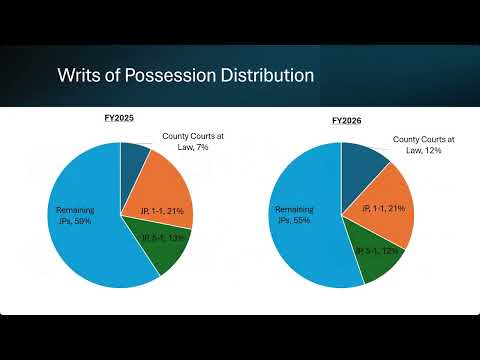
Judges, constables and tenant advocates told the Continuous Improvement Steering Committee on March 9 that Rule 11 pretrial agreements and targeted incentives for landlords can reduce executed evictions and limit the harm of higher writ-of-possession fees.
"Rule 11 agreements do significantly work," Judge Jones (Precinct 4) said, describing settlements that let tenants vacate without an eviction on their record. Judge Steve Snyder (Precinct 3, Place 2) told the committee that his court's use of Rule 11 has led to lower eviction rates and fewer writs of possession being executed.
Snyder urged caution about using high fees to deter filings: "If the mental-illness warrants if you wanna see them go down, they can go down 90% — just start assessing $500 or $400 fees. They won't come. But what we're gonna have ... is family members standing in front of you with a son, a daughter, a mother that's suicidal or homicidal or in distress that needs a mental-illness warrant." That comment underscored judicial concern that higher costs can deter needed court processes.
Mark Melton, who identified himself as founder of a Dallas tenant-advocacy organization, said his group represented tenants in 7,512 eviction cases last year and is on track for about 9,000 this year. Melton emphasized that most people affected are low-income: "They're almost universally all poor. 82% of them across the board under 200% of the federal poverty line regardless of where they live in the county."
Several judges proposed piloting an incentive tied to Rule 11: offer landlords a partial rebate or credit on a writ fee if the parties enter an agreed Rule 11 resolution that avoids an executed writ. One judge suggested using homeless-prevention funds to underwrite a rebate that could reduce the writ charge to a lower amount when a Rule 11 agreement succeeds.
"To date, they've been participating, but there's been some changes in the rules," a judge said, describing how on-site staff attorneys and court-managed settlement meetings have helped tenants secure dismissals or orderly departures. The proposed pilot would be voluntary and limited to a subset of JP courts so staff could measure housing outcomes and administrative impacts before broad implementation.
Advocates and some constables warned, however, that local variations matter: filing and eviction patterns differ across precincts. One constable said he expected caseloads to drop with the fee increase but worried landlords in lower-income neighborhoods might attempt illegal lockouts instead.
The committee did not adopt a pilot at the meeting. Commissioners suggested staff and judges jointly design a small trial in select JP courts, then return findings on eviction outcomes, administrative burden and fiscal implications.
What happens next: staff were asked to draft a pilot plan for a voluntary Rule 11 incentive, including legal review, administrative workflow and a short-term performance metric set to report back to the committee.