Get Full Government Meeting Transcripts, Videos, & Alerts Forever!
Get email alerts on the Sheriff Constable Fees topic
No spam. Unsubscribe anytime.
Dallas County budget office projects up to $3 million from fee increases; commissioners raise collection and state-share concerns
Summary
Budget office analysts told the Continuous Improvement Steering Committee that increases to writ-of-possession and mental-illness-warrant fees could boost county receipts, but judges and commissioners warned courts are waiving fees and that the state's portion and collection practices could blunt or expose the county to liability.
Alexis Galloway, a budget-office analyst for Dallas County, told the Continuous Improvement Steering Committee on March 9 that recent fee increases for writs of possession and mental-illness warrants could substantially raise county receipts.
"For this data, we extracted from Odyssey for the Justice of the Peace Courts, County Court at Law, and for Probate Court No. 3," Galloway said, and she summarized key legal constraints: Local Government Code §118.131 requires fees be no higher than necessary to cover the expense of providing the service and be set annually before Oct. 1 to take effect Jan. 1.
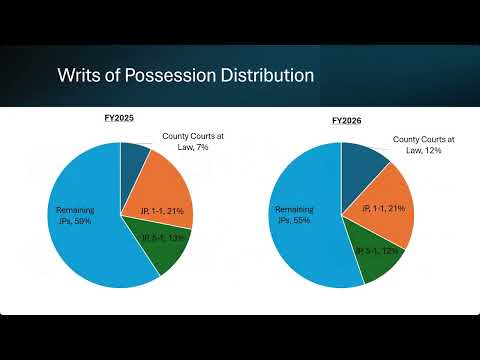
Galloway said the writ-of-possession fee rose from $170 to $400, a 135% increase, and that county records show more than 11,000 writs of possession filed in FY25 generated about $2.0 million. Based on FY26 projections of roughly 9,000 filings, Galloway said the county could see about $2.9 million in receipts for writs of possession in FY26—about $903,000 more than the prior year.
On mental-illness warrants—used to authorize apprehension and transport to mental-health facilities—Galloway said the fee increased from $150 to $350 (133%). She told the committee that if a fee had been assessed on every mental-illness warrant filed in FY25, the county could have collected roughly $1.6 million; for FY26 she estimated the county ‘‘could experience approximately $3,000,000’’ (the increase attributable to the higher fee).
But several judges and county staff told the committee those theoretical receipts may not materialize. A county staff member reported that courts have been waiving the mental-illness-warrant fee and that "no revenue was received in '25, and no revenue has been received for FY26 as of February," meaning the fee increase alone had not produced collections.
Commissioners asked whether the auditor's office had verified that the new fees match the county's cost to provide services. County staff said the auditor had analyzed the cost before a previous increase and that the proposal under discussion was intended to recoup a portion or all of the county's service costs. Auditor staff explained their methodology depended on personnel and process inputs and that the recommended rates were intended to cover the "actual cost to provide the service." The auditor's representative said some recommended fees remain below the calculated cost per event.
Several commissioners pressed for clarity on how much of any collected fee would be retained by the county and how much would be the state's portion. A county official said that, according to the district attorney's office, part of the fee is the state's portion and that if state courts demand their share the county would likely satisfy that obligation from the general fund unless otherwise accounted for.
"We collect the fee and then there's a breakdown as it relates to percentage," a staff member said. Commissioners requested staff calculate the state's percentage and the county's potential exposure if the state seeks retroactive payments.
Budget staff also warned of practical collection issues: even with higher rates, filings may fall (fewer writs or warrants filed) or courts may waive fees, and some types of fees (for postings and citations) were noted as not yet implemented correctly in the county's case-management system. Precinct staff told the committee that a statutorily required $20 posting fee had not been applied in the system and that, in effect, some service actions were being performed without recovering that charge.
The committee did not adopt a new fee schedule at the meeting. Members asked for follow-up work: (1) a detailed cost-offset and collection analysis by the auditor; (2) a calculation of the state's share and potential retroactive exposure; and (3) clarification whether the $20 statutorily required posting fee is included in the new amounts or must be processed separately. Commissioners instructed staff to return with those figures before finalizing any next steps.
Votes and formal motions at the start and end of the meeting were procedural: members moved to open the meeting and to review the report; both motions passed by voice vote. A motion to adjourn passed at the close of the session.
What happens next: staff agreed to provide the requested cost and collection calculations and a breakdown of allocations to the state so the commission can assess legal and fiscal exposure before approving any further administrative steps.