Get Full Government Meeting Transcripts, Videos, & Alerts Forever!
Get email alerts on the Subdivision Enclave Loondale topic
No spam. Unsubscribe anytime.
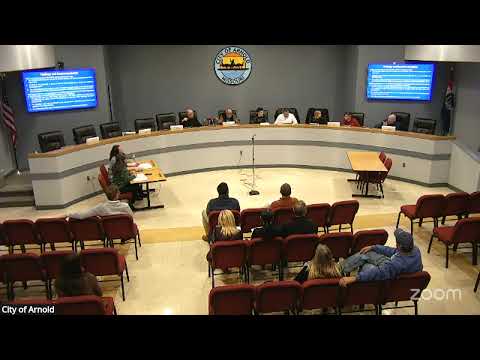
Planning commission recommends Enclave at Loondale preliminary plat to city council despite resident runoff concerns
Summary
The Arnold Planning Commission voted to recommend the 12-lot Enclave at Loondale preliminary plat to city council (motion passed with one dissent). Staff recommended approval with conditions; residents raised concerns about existing drainage and potential increased runoff; the applicant described a nested detention and bioretention design.
The Arnold Planning Commission voted in executive session to recommend the Enclave at Loondale preliminary plat (PC2025-31) to city council, carrying the motion with one dissent.
Staff presented the application as a proposal to subdivide two existing parcels at 2162 Loandell Road into 12 single-family residential lots in the R-4 district. Christie, planning staff, told commissioners that the preliminary plat meets subdivision regulations, includes required streets, sidewalks and easements, and conforms to the comprehensive and capital improvements plans. Staff recommended favorable consideration to the council subject to standard findings and conditions, and required sidewalk contributions to tie in to adjacent public-works projects.
The application drew extensive discussion about stormwater. Kevin Betzer, a Deborah Lane resident, said existing runoff already floods yards and roadways near the site and worried the new development would worsen those conditions: “Everything from that project is gonna pour in between them two homes … it’s gonna flood out that whole area,” he said. Christie said staff is aware of downstream issues and that a hydraulic analysis will be required with improvement plans to evaluate capacity.
Applicant engineer Igor Gusa of Henningen and Associates responded that the site’s topography funnels flow to the lowest point, and described a swale/interception system and a nested detention/bioretention approach intended to capture routine storms and slow release during larger events. “In our calculation, we show a reduction of water coming out of the property as post conditions, which meets the city codes,” he said.
Commissioners asked for full improvement plans and engineering details at record plat stage and noted that any off-site improvements or easements needed to provide a legal discharge point must be addressed before final plat approval. Staff emphasized that final plat approval will not be granted until public facilities and drainage provisions are in place.
The commission’s favorable recommendation will move the preliminary plat and staff conditions to the city council for final consideration.