Get Full Government Meeting Transcripts, Videos, & Alerts Forever!
Get email alerts on the Artificial Intelligence topic
No spam. Unsubscribe anytime.
UN chief lays out four AI priorities and urges transparency, calls to ban 'killer robots'
Summary
At a UN briefing the spokesperson relayed the secretary-general's four priorities for AI governance — safety (including an "AI child safety" pledge), human-rights red lines, capacity-building, and environmental transparency — and repeated his call for an international ban on lethal autonomous weapon systems.
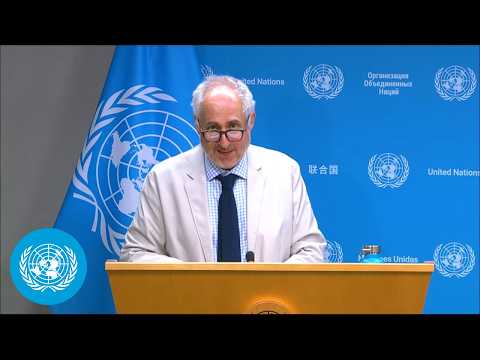
At a United Nations press briefing, the spokesperson Stefan said the secretary-general used the inaugural global dialogue on AI governance in Geneva to present four priorities for international action on artificial intelligence: safety, human-rights ‘red lines,’ capacity-building to avoid an AI divide, and transparency about environmental impacts.
Stefan summarized the secretary-general's proposals, saying the first priority is safety and noting a call for an "AI child safety" pledge so that when a child is harmed the answer is not simply "the algorithm did it." The second priority, Stefan said, is establishing red lines to protect human rights. The third is increasing capacity so the digital divide does not harden into an AI divide. The fourth is an environmental-transparency initiative that would require companies to measure and publicly disclose the footprint of their systems and to commit to powering every data center with renewable energy by 2030.
"The choice before us is not between faith in AI or fear of it," Stefan said, relaying the secretary-general's formulation at the dialogue, and added that the secretary-general would submit recommendations to the General Assembly on a proposed global fund for AI.
On military uses of AI, Stefan relayed that the secretary-general raised the issue of lethal autonomous weapon systems and reiterated a call for an international law ban, saying some decisions — "none more than taking a human life" — must remain in human hands.
Why this matters: the secretary-general's priorities, if adopted by member states or translated into international agreements, could shape rules for the development, deployment and environmental reporting of AI systems and influence funding for global capacity-building. The UN-backed transparency and funding proposals would also affect private-sector reporting and national regulatory approaches.
Next steps: Stefan said the secretary-general will forward recommendations to the General Assembly and that the global dialogue is intended to craft pathways from participation to global action.