Get Full Government Meeting Transcripts, Videos, & Alerts Forever!
Get email alerts on the Parking Permits topic
No spam. Unsubscribe anytime.
Residents’ outcry leads Elmwood Park council to table Rosemont residential-parking trial
Summary
After a two-hour public hearing in which residents and business owners raised concerns about notification, fees and impacts on Broadway businesses, the Elmwood Park Mayor and Council voted to table a proposed one-year residential parking-permit trial for the Rosemont section for further review.
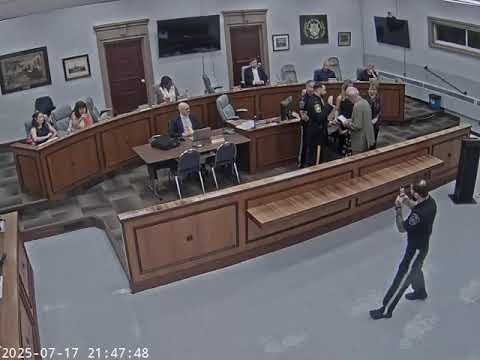
The Elmwood Park Mayor and Council on July 17 put on hold a proposed one-year residential parking-permit pilot for the Rosemont neighborhood after sustained public opposition and questions about the ordinance’s details.
The ordinance under consideration (introduced as ordinance 25-15 on second reading) would make certain streets resident-only from 9 a.m. to 8 p.m., seven days a week, for a one-year trial and would require sticker permits for households. Council and staff described a draft fee structure as $25 for a first vehicle and a lower fee for additional vehicles (a staff member referenced $10; another exchange noted $20). Officials told residents revenue would be used for signage, posts and permit materials, and the draft includes two free visitor passes per household for short visits.
Why it mattered: Neighbors said the plan would put an unfair cost burden on residents, risk diverting economic activity from Broadway-area businesses and had insufficient public outreach. John Gilmore, who said he was speaking for a family member stationed overseas, asked bluntly whether the pilot would charge residents and objected that only 48 of roughly 135 households responded to a March survey. “If the goal is to test whether permit parking helps alleviate business-related overflow, the burden should not fall on the very residents it affects,” Gilmore said (John Gilmore, resident, speaker 20).
Local business owners warned of lost customers if nearby side streets were closed to nonresident parking. “To have no parking for a business is basically putting us out of business,” said Irv Lucan, owner of a record store on Broadway (Irv Lucan, business owner, speaker 13). Multiple residents argued a time-limited approach for nonresidents or improved enforcement of existing restrictions would be less disruptive.
Council and staff responses: Police and staff said the borough canvassed affected streets and collected 48 survey responses, 38 of which were recorded in favor; Chief Michael Foligno described the delivery and polling process and said the sampling was the basis for the council’s decision to proceed to a hearing. The mayor and several council members acknowledged that communication could have been better and that the sample size left unanswered questions.
Outcome: After hearing dozens of residents and business owners, Councilman Fasolo moved to table the ordinance for further review; the motion passed on roll call (Fasolo, Golubek, Sampson, Sheridan, Joysey and Council President Pellegreni voting yes). Mayor Colletti said the council would take additional time to work through fee structure, notification methods and implementation details before bringing a revised proposal back.
What’s next: The council said it would revisit the ordinance after further outreach and staff follow-up; no final permit structure or specific effective date was adopted at the meeting.
Provenance: Topic introduced at SEG 808 and the public hearing concluded with the motion to table at SEG 2764.