Get Full Government Meeting Transcripts, Videos, & Alerts Forever!
Get email alerts on the City Budget Sales Tax topic
No spam. Unsubscribe anytime.
Weed city manager outlines roughly $1.5 million budget gap and presents 1.5% sales-tax measure as voter option
Summary
City Manager Dustin Stambaugh told residents in a recorded webinar that Weed faces an approximately $1.5 million general-fund shortfall driven by rising personnel and infrastructure costs and that a 1.5% local sales-tax measure is one option the council is discussing; any measure would require voter approval.
City Manager Dustin Stambaugh told residents in a recorded webinar that the City of Weed is facing a persistent general-fund shortfall driven by rising personnel, insurance and construction costs, aging infrastructure and increased demand for emergency services.
"We are projecting approximately $6,180,000 in general fund revenue compared with approximately $7,700,000 in planned expenditures," Stambaugh said, calling the resulting budgeted difference "about $1,520,000." He also described an "approximately $1,600,000 deficit" elsewhere in his remarks, indicating the shortfall is on the order of about $1.5 million.
Why it matters: Stambaugh framed the shortfall as a risk to core services residents rely on daily — police, fire, streets, water and sewer — and tied it to specific pressures: an aging wastewater system (some parts dating to the 1940s), roughly 25 miles of roadway the city maintains, an estimated 15 miles needing repair, and a sharp increase in fire calls (402 in 2023 to 812 in 2025).
Stambaugh said the city has pursued grants aggressively and that staff have been able to leverage more than $50,000,000 in grant funding, but stressed grants typically pay for building projects rather than ongoing maintenance or staffing costs: "Grants will help us build things, but local revenues help us operate and maintain them."
General-fund priorities and constraints: According to Stambaugh, about 35% of the general fund supports police, 15% supports fire and 15% supports public works, leaving limited flexible dollars for other needs. He also said 70% to 80% of Weed's sales tax comes from fuel and service stations and from travelers along Interstate 5, making local revenue vulnerable to factors beyond city control.
What the city is proposing: One option the city council is discussing is a 1.5 percentage-point local sales-tax measure. Stambaugh said that if voters approved such a measure, the city's overall sales-tax rate would move from 7.5% to roughly 9.0%, and the increase could generate an estimated $1.5 million to $2.0 million annually for the general fund, based on current estimates. He emphasized any measure would require voter approval and that the city's role is to provide information to voters.
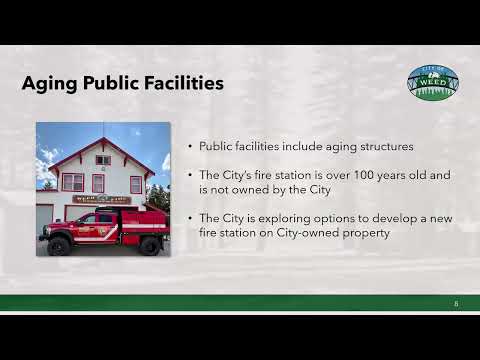
Facilities and staffing: Stambaugh highlighted aging public facilities, including work recently done at City Hall, and a more-than-100-year-old fire station that is not currently owned by the city. He thanked — as stated in the presentation — "Roseburg and Kirk Andrews, our district attorney, for agreeing to pay for phase 1" of a proposed new fire station; the presentation transcript does not clarify Roseburg's organizational role or relationship to the project.
Staffing shortages are also affecting service capacity: Stambaugh said the police department is authorized for nine officers with one vacancy remaining, volunteer participation has declined and recruitment is difficult because larger agencies can offer higher pay and incentives.
Next steps: Stambaugh framed the webinar as informational and said the decision to place any tax measure on the ballot would rest with voters. He invited questions via the webinar Q&A and said city staff and council will continue exploring options, efficiencies and grant opportunities as they consider next steps.
No formal vote or ordinance was taken during the webinar; the presentation was informational and aimed at helping residents understand the city's fiscal position and the tradeoffs involved in potential revenue measures.