Get Full Government Meeting Transcripts, Videos, & Alerts Forever!
Get email alerts on the Animal Control Ordinance topic
No spam. Unsubscribe anytime.
Eagle Pass Animal Welfare Board reviews major revisions to animal control code, proposes anti-dumping ordinance
Summary
Board members at a July 6 workshop reviewed proposed changes to Chapter 6 covering enforcement, definitions for enclosures and kennels, shelter standards, and a new ordinance to ban abandonment/dumping of animals; staff will draft language and return revised sections for a vote at the next meeting.
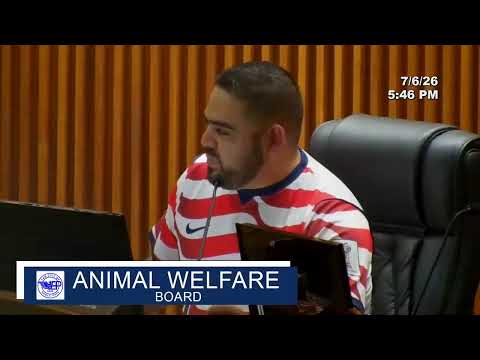
The Eagle Pass Animal Welfare Board met on July 6, 2026, in City Hall’s Council Chambers to workshop amendments to Chapter 6 of the city municipal code governing animals. Chairwoman Catherine Suarez led members and staff through sections on enforcement authority, definitions for enclosures and kennels, shelter standards, and a newly proposed ordinance aimed at prohibiting abandonment and unlawful dumping of animals.
The meeting opened with the board approving minutes for May 4 and June 1 by voice vote. Captain Alex Barrientos read selected sections of the proposed ordinance. Section 6-1 (purpose) remained largely uncontroversial as framed to protect both animals and residents; Section 6-2 (enforcement) drew more attention when the reading clarified that animal-control officers, police and other designated personnel would investigate complaints and, in certain circumstances, may use force, tranquilization or other measures to protect people or relieve animal suffering. As Captain Barrientos read the enforcement language, he said the code allows officers to “shoot any animal to protect themselves, to protect a third person, or to protect other animal from attack or threat of imminent injury,” language board members discussed for clarity and alignment with state law.
Members spent significant time on Section 6-4 (definitions). The board debated the ordinance’s enclosure sizes and whether requirements should vary by breed or by the number and size of animals. Assistant Chief Garza warned that strict permanent-enclosure requirements for dogs designated as dangerous — such as multiple 5-by-10-foot concrete enclosures with roofs and separate insurance for each animal — can impose heavy financial burdens on owners and lead to more animals being surrendered to the shelter. Garza said the city’s current shelter, built in 1992, uses fans and heaters seasonally and “would probably not be able to comply if you ask for a temperature facility” as a mandatory standard, a point members said should be considered when drafting final language.
The board also examined kennel definitions and whether to require certificates of occupancy and other qualifications for commercial facilities, not hobby or home-based situations. Members proposed comparing language used by other Texas cities to avoid unintended consequences such as informal home-based kennels operating without necessary standards.
Other substantive edits discussed included: clarifying the difference between stray and unowned animals; collapsing repetitive items in the prohibited-animals list; adding livestock to the definition of competition animals to reflect local agricultural events; and rewording public-nuisance language to align with state standards on what constitutes unreasonable disturbance (members suggested terms such as “disturbs” rather than “annoys”). The board flagged several places where ordinance language appeared out of date (some sections dated to 2018) and directed staff to modernize the code where needed.
Chairwoman Suarez introduced a draft of a new ordinance targeting abandonment and unlawful dumping of animals, saying she modeled the proposal on language used by other nearby jurisdictions and had prepared an initial draft for the board to review. Suarez said the draft would include reporting and enforcement mechanisms and use municipal fines and applicable state statutes. Members discussed the jurisdictional limits of city enforcement and the importance of partnering with county counterparts, noting the county animal-control fleet recently lost a truck and this complicates joint enforcement in areas where animals migrate from county jurisdiction into the city.
Board members agreed on a practical workflow for finishing the chapter: staff asked members to send recommended language changes by email to staff member Beto so staff could draft ordinance language with tracked edits for the board to review; the board will work in sections (roughly 10 sections per meeting) rather than attempting to rework the entire chapter at once. Staff indicated the board’s edits to the sections reviewed at this meeting (approximately 6-1 through 6-10) would be finalized and brought back for a vote at a subsequent meeting.
Votes at a glance - Motion to approve minutes for May 4 and June 1: moved by Ruben Camarillo; seconded and approved by voice vote (motion carried). (Evidence: motion began at the meeting’s approval-of-minutes section and concluded with the chair announcing the motion carries.) - Motion to adjourn: moved by Chair Catherine Suarez; approved by voice vote. Meeting adjourned at 6:48 p.m.
What’s next Board members and staff will exchange draft language by email; staff will produce a revised ordinance with tracked edits and bring updated sections back for formal consideration and vote at a future monthly meeting. The chair signaled intent to have the proposed abandonment/dumping ordinance included in the board’s packet for forthcoming review.
Quotes “It's actually gonna be a brand new…abandonment or unlawful dumping of dog of animals. I think that's something that we need to introduce,” Chair Catherine Suarez said while presenting her draft proposal. Assistant Chief Garza described facility limits: “Right now, we have a shelter that was, 1992 built, and…we would probably not be able to comply if you ask for a temperature facility.” Captain Alex Barrientos summarized enforcement wording under discussion: “Animal control officers and police officers have the authority to shoot any animal to protect themselves…or to prevent such animal from enduring further pain or suffering.”
The board scheduled email and drafting tasks with staff and agreed to continue reviewing the ordinance in sections at upcoming meetings.