Get Full Government Meeting Transcripts, Videos, & Alerts Forever!
Get email alerts on the Parking And Tdm topic
No spam. Unsubscribe anytime.
San Leandro council advances parking and transportation-demand-management ordinance to second reading
Summary
Council heard staff presentations and public testimony on proposed zoning changes to reduce parking minimums and establish TDM rules for new developments; after questions and public input, council voted 4–1 to return the ordinance for a second reading and further chamber discussion.
Mayor Gonzales opened a public hearing July 6 on a first-reading zoning ordinance to modify off‑street parking rules and adopt transportation demand management (TDM) requirements for new development. Lourdes Juarez, associate planner for the Community Development Department, said the package responds to Housing Element Action 14.1 and reflects stakeholder outreach and a 2025 parking and TDM study prepared with consultants W‑Trans and Nelson ygaard.
Brian Kanepa of W‑Trans outlined key findings: existing local parking minimums generally exceed observed peak demand, parking is costly to build (roughly $10,000 per surface space to $70,000–$100,000 per underground space), and opportunities exist for consolidated land‑use categories, reduced minimums outside transit areas and elimination of remaining minimums within a half‑mile of major transit per AB 2097. Kanepa said the proposal also includes bicycle parking standards, unbundled parking pricing and recognition of shared‑parking opportunities consistent with AB 894.
Alex McCurrey of Nelson Nygaard described the TDM approach as a calibrated, starter program designed to minimize upfront costs while building capacity. He said mandatory low‑cost measures, a small menu of optional strategies, streamlined submittals and biennial mode‑share surveys would apply to projects above thresholds the consultants recommended (25 units for residential and 50,000 gross sq ft for nonresidential), with a self‑certification and monitoring path for compliance.
Council members probed implementation details: how standards would affect small storefronts in shared parking lots; whether reduced minimums would push cars into neighborhoods; and the expected cost impact on a hypothetical 25‑unit building (staff said the TDM menu and many measures were intended to have little or no net new cost). Public commenters raised neighborhood parking concerns and encouraged protections for single‑family areas.
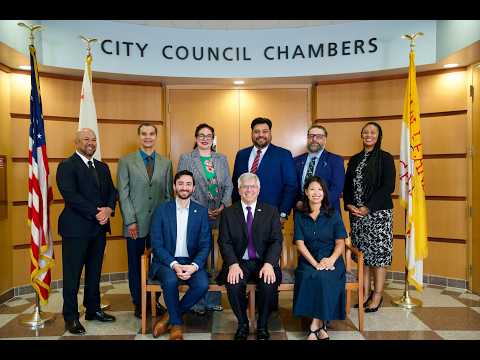
After deliberation, Council member Sue Bowen moved that the ordinance return to the council for a second reading and chamber discussion rather than be placed on consent. The motion was seconded by Council member James Aguilar and passed by roll call: Fred Simon, James Aguilar, Sue Bowen and Dylan Bolt voted yes; Mayor Gonzales voted no; Council member Victor Aguilar and Vice Mayor Viveiros Walton were absent. The council’s action means the ordinance will be revised and scheduled for a formal second reading where further debate and potential amendments can occur.
Staff materials referenced a parking and TDM study in the council packet and identified the recommended amendments as codified changes to zoning code chapters related to street parking and transportation demand management. The council did not adopt the ordinance tonight; next steps are a second reading and additional chamber discussion.