Get Full Government Meeting Transcripts, Videos, & Alerts Forever!
Get email alerts on the Education Open Enrollment topic
No spam. Unsubscribe anytime.
Committee hears testimony on open-enrollment package that would ban arbitrary denials and remove criminal penalties for enrollment errors
Summary
The House Education and Workforce Committee heard testimony on a three‑bill open-enrollment package that would require districts to accept nonresident students when seats exist, increase transparency about seat availability, and eliminate criminal penalties for parents who provide incorrect enrollment information; parents and advocates stressed special‑education access and recounted prosecutions under the current law.
The House Education and Workforce Committee on July 8 heard testimony on a package of bills aimed at expanding and standardizing open enrollment across Michigan public school districts, including proposals to require districts to accept nonresident students when capacity exists, publish seat‑availability data, and remove criminal penalties for parents who provide false or incomplete enrollment information.
Representatives who sponsored the bills urged the committee to approve the package. Representative Aultman, testifying in support of HB 53 10, said the measure would guarantee families “a fair shot” by preventing districts from denying enrollment for arbitrary reasons and by requiring districts to apply the same standards to residents and nonresidents. She said the proposal is “capacity‑driven, not mandatory expansion,” and that districts would retain the authority to deny enrollment where there is no room or where safety and program capacity are concerns.
Supporters stressed equal treatment for students with disabilities. Representative Regas said the companion bill, HB 53 12, would align the Revised School Code with the open‑enrollment reforms and ensure nonresident special‑education students retain access to a free appropriate public education and individualized education programs as required under federal law.
Several committee members pressed sponsors on operational and fiscal impacts. Representative Boyce asked whether the package would eliminate the ability of some districts to opt out of choice and warned of potential enrollment and budget disruptions in surrounding districts; Aultman responded that the bills are designed to let districts determine capacity by building and grade and that she had not seen evidence of destabilizing transfers in existing choice programs. Representative Colazar raised concerns about staffing and teacher shortages; sponsors reiterated that the bills do not require districts to add programs or exceed locally defined capacity.
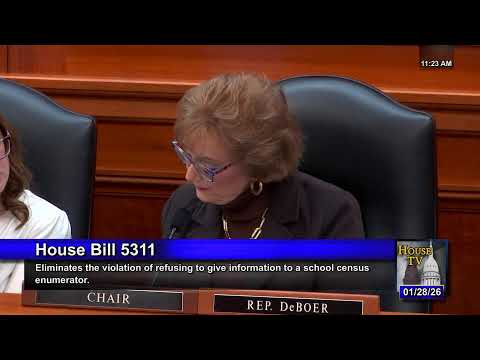
The package includes HB 53 11, which Representative Liberati described as removing criminal penalties for a parent or guardian who uses false information to enroll a child in a nonresident district and requiring that a child seeking to attend the following year apply through the normal choice process. Liberati said prosecution of parents in these cases is rare and that criminal penalties are an excessive response when families seek better educational fits for their children.
Several parents testified about barriers for special‑education students and the human cost of current enforcement. Carrie Bialik said both her twins have IEPs and described ongoing noncompliance by districts, seclusion, and an incident in which a paraprofessional “told him to stop acting like a stupid retard”; she said schools sometimes require families to sign away services or refuse to release funding needed to provide required supports, effectively blocking transfers for special‑education students.
Another parent, Kelly Williams Ballore, described being investigated by a private investigator, receiving an indictment, serving jail time on felony counts she said related to district enrollment claims, and losing her father while he was in custody. Ballore urged lawmakers to remove criminal penalties, saying prosecuting parents for seeking a better school for their children can cause lasting harm.
Policy advocates urged the committee to pass the bills. Dorel Bradford of 50CAN (Available to All) and Alicia Thomas Searcy of the Center for Strong Public Schools, both testifying virtually, said clearer rules, seat‑availability reporting and a statewide transparency framework make transfers manageable and help correct segregation and unequal access. Bradford cited a national estimate that about 1,600,000 students use open enrollment to find a better public‑school fit.
Not all stakeholders registered support: the committee record includes organizational opposition from groups such as the Michigan Association of Intermediate School Administrators, Calhoun ISD, the Michigan Education Association, Wayne RESA and the Michigan Association of Superintendents and Administration. Several business and policy groups registered support without speaking on the record.
No committee vote was taken on the bills. The committee adopted the Jan. 21 minutes without objection, excused absent members and adjourned after hearing testimony. Sponsors and witnesses said next steps would involve additional questions from members and further testimony; the committee did not take formal action on the bills during this hearing.