Get Full Government Meeting Transcripts, Videos, & Alerts Forever!
Get email alerts on the Provider Impact topic
No spam. Unsubscribe anytime.
Providers and families tell lawmakers revalidation errors left services unstable; advocates call for waivers and fixes
Summary
More than a dozen providers and advocates testified that portal glitches, lost records and delayed site visits left long-running providers disenrolled, payments suspended and families without essential care. Testimony included cases of families losing multiple aides and at least one medical crisis tied to service loss.
At a July 1 Senate Human Services Committee hearing, more than a dozen providers and advocates gave two-minute statements describing immediate harms they say resulted from MinnesotaDHSprovider revalidation operations: suspended payments, terminated enrollments, lost portal data and site-visit mistakes that providers say were administrative rather than fraudulent.
"I've done everything you've requested, and I'm still penalized. I'm still terminated at this point," said Linda Fairchild, who told the committee she submitted revalidation documents months earlier yet received a termination notice on May 31. Fairchild said her family residential service home has operated for decades and that the termination, combined with reimbursement reductions, threatens her ability to continue providing care.
Advocates described family-level emergencies. Tricia Brissbine, a disability advocate, recounted multiple families who lost personal care assistance staff with little notice; she said one adult with significant disabilities spent a week in an intensive-care unit after losing essential in-home supports. Fatima Mollis of the Multicultural Autism Action Network said, "Our phones have not stopped ringing. Parents are calling us crying, panicked, desperate," and described parents who must lift and turn medically complex children alone overnight.
Providers gave consistent operational examples: documents that disappeared from the MPSC portal; site visits conducted at the wrong address; multiple surveyors producing inconsistent findings; training webinars that failed to load, leaving providers unable to meet new requirements. Mark Mata, whose family company has operated since 1974, said his organization received three different termination letters after three different site visits that recorded contradictory interview results.
Financial strain: multiple speakers said DHSimmediate payment suspensions—sometimes later partially reinstated—left nonprofits and small providers operating without cash reserves for weeks. Amy Winn, program director at Pine River Group Home, said her nonprofit continued providing care for roughly two weeks without full reimbursement and that the lost revenue threatens payroll for staff and the stability of homes that house vulnerable Minnesotans.
County and systems perspective: county officials told the committee they are working around the clock to triage DHS lists of potentially affected people, but the raw lists are large, change hourly and lack prioritization flags. Paul Verrett (Minnesota Association of County Social Service Administrators) said counties need triageable data to find those at greatest risk of losing residential services.
Calls for fixes: witnesses urged a set of immediate responses including temporary waivers to allow service authorizations and hiring of new staff, faster appeals processing and a provider-impact task force. Dr. Eric Larson, representing autism providers, asked for a temporary waiver of restrictions on enrolling new staff and submitting authorizations so families can continue to receive services while DHS completes revalidations.
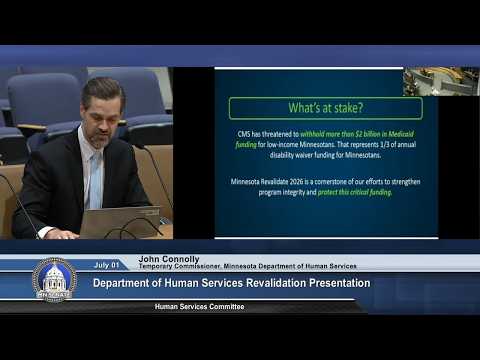
DHSresponse and next steps: Acting Commissioner Connolly repeatedly said DHS is trying to balance program integrity with continuity of care, that appeals can restore billing when active, and that the department will follow up on reports of specific site-visit or portal errors. Committee leaders asked DHS to provide more detailed output from the Optum review, appeals staffing levels and ongoing case-level follow-ups. No formal votes were taken; lawmakers signaled further oversight would continue.
The human picture: providers and families told the committee the consequences are concrete: reduced staff capacity, closed beds and exhausted families facing immediate safety risks. Multiple witnesses urged rapid operational fixes and explicit protections so providers who are complying are not forced into closures or do not put recipients at risk.