Get Full Government Meeting Transcripts, Videos, & Alerts Forever!
Get email alerts on the Medicaid Provider Revalidation topic
No spam. Unsubscribe anytime.
Senate committee grills DHS after CMS-directed five-month Medicaid revalidation; thousands of providers disenrolled or appealed
Summary
Acting Commissioner Connolly told the Senate Human Services Committee that a CMS-directed off-cycle revalidation over five months identified 5,583 providers in 13 service lines; roughly 2,000 were revalidated, about 3,400 received disenrollment notices and thousands are in appeal. Lawmakers and providers pressed DHS over continuity-of-care risks, portal failures and communication breakdowns.
Acting Commissioner Connolly told the Senate Human Services Committee on July 1 that Minnesota completed an off-cycle Medicaid provider revalidation across 13 service lines after a compressed, five-month effort ordered by the Centers for Medicare and Medicaid Services (CMS).
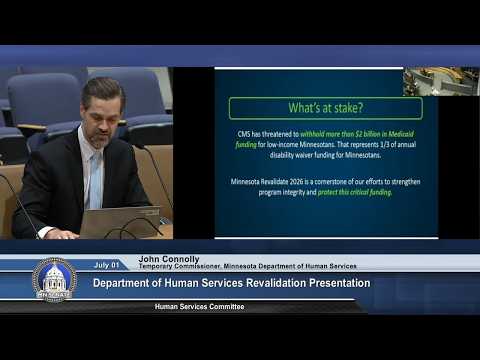
The revalidation, Connolly said, was a central element of MinnesotaDHScorrective action to address CMS program-integrity concerns and to avoid large federal withholdings. "CMS basically directed us in letters on December 5 and January 6 ... that this was something that had to happen," Connolly said in opening remarks. He described the fiscal risk as substantial: the committee heard figures citing roughly $2,100,000,000 in potential withholdings and additional claim deferrals.
Why it mattered: the corrective-action timeline was compressed to what DHS described as the fastest feasible schedule after pushback from CMS; other states were given as long as two years for similar work. Connolly said the departmentstood up an incident-command structure, brought in staff statewide, made nearly 10,000 outreach calls and held weekly coordination with counties, tribal nations and managed-care organizations to protect continuity of care.
Key numbers presented by DHS: 5,583 providers were identified in the 13 targeted service categories; about 2,000 (roughly 38 percent) were revalidated successfully and the remainder received disenrollment notices. At the time of Connollyreporting, DHS said there were about 2,151 appeals in process, 321 appeals completed, and roughly 353 providers whose appeal window had closed and were being disenrolled. Connolly repeatedly cautioned that the figures were changing by the hour as appeals progressed.
Committee concerns and DHS responses: lawmakers pressed for specifics on how DHS prioritized providers, why the timeline could not be extended, and what immediate steps were being taken to prevent interruptions in care. Senator Erin Maye Quade and others asked whether Minnesota had tried to negotiate a longer timeline; Connolly said CMS had repeatedly pressed DHS to execute a rapid corrective action and that the department believed the five-month schedule was the fastest legally feasible response given the funding risk.
On continuity of care, Connolly said DHSpolicy allows providers who file an appeal to resume billing and that DHS had restored billing ability for many providers within one to two weeks. He said the agency is meeting weekly with lead agencies and MCOs, urging providers to appeal quickly (the formal appeal window is 60 days, DHS encourages appeals within seven days) and using new legislative resources to do more direct outreach.
Operational gaps identified: lawmakers and testifying providers described a range of operational failures beyond the federal directivein particular, persistent problems with the provider portal (MPSC / MNLogin), lost or disappearing records, delays in site visits and inconsistent communications. Representative Zalesnikar, Senator Lisky and others described providers who submitted documentation well in advance yet still received termination notices because their records remained "pending" in the portal. Multiple providers and advocates said DHScompleted some site visits at the wrong addresses or recorded incorrect interview results, producing termination notices that providers say were based on clerical or system errors rather than fraudulent behavior.
Claims and tensions in the room: some members framed CMS actions as coercive; Chair Noor said, "To me ... that is weaponizing Medicaid for those who need the most," language echoed by members critical of the federal intervention. DHSresponded that the effort is a program-integrity and compliance exercise, and that a disenrollment notice does not by itself mean fraud. Connolly said DHS referred 59 providers to the inspector general for program-integrity concerns as a result of revalidation and that, since early 2025, more than 700 cases had been referred to the U.S. Attorney and the Minnesota Attorney General for investigation.
What providers told the committee: many providers and advocates testified that they followed DHS instructions, submitted documents in good faith and nonetheless faced suspension of payments, enrollment termination notices or multi-week delays in receiving remittances. DHS officials acknowledged some mistakes and pledged case-by-case follow-ups and corrective site visits where needed.
What happens next: the committee closed by emphasizing oversight and continuing work with DHS to stabilise provider relationships. Connolly said DHS is balancing program integrity with preserving provider access and that the agency would continue to adjust operational processes while working with counties, tribes and providers to reduce service interruptions.
The hearing produced no formal votes; members requested further data (including the Optum report and detailed appeals staffing numbers) and signaled additional oversight meetings may follow as appeals and process corrections continue.