Get Full Government Meeting Transcripts, Videos, & Alerts Forever!
Get email alerts on the Elections topic
No spam. Unsubscribe anytime.
Bill would remove street addresses from nominating petitions, require congressional residency disclosure
Summary
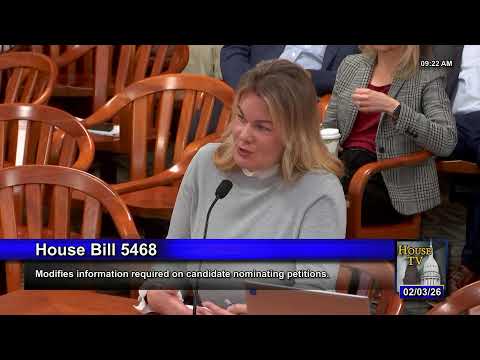
Representative Smith told the committee HB 54-68 would strip street addresses from nominating petitions (keeping county of residence) and require congressional candidates to state whether they live in the district. Members raised concerns that affidavits remain public (FOIA) and may undercut privacy goals.
Representative Smith introduced House Bill 54-68, which would change what information appears on a candidate’s nominating petition and add a required statement for congressional candidates indicating whether they are residents of the district they seek to represent. Sponsor said the intent is to reduce exposure of candidates’ street addresses circulated publicly while still preserving county-level information and a website field if available.
"Because this, nominating petitions are public documents, the candidate street address may unnecessarily expose them to risk," Representative Smith said, describing the bill as a privacy safeguard. She emphasized the petition change would not remove the address from the affidavit of identity, which remains a verification document.
Representative Colazar asked whether the street address still appears on the affidavit of identity; Representative Smith confirmed it does. Committee members pressed that affidavits are public and can be obtained via FOIA, and that leaving the affidavit public may blunt the privacy benefit. Representative Altman asked whether removing addresses from petitions but leaving them on an affidavit makes the change ineffective in practice; Representative Smith agreed the tension exists and suggested exploring further changes within the framework of the recently passed Elected Officials Protection Act.
Representative Zong, who said privacy is important to her, noted some candidates already list PO boxes and that the secretary of state’s candidate list includes addresses; she urged stronger protections. Members discussed whether residency verification should be required for congressional candidates or whether the bill should be expanded to the affidavit or other documents.
The bill received cards of support from the Michigan Association of County Clerks, Promote the Vote, and Pure Integrity, Michigan Elections. The committee did not vote on HB 54-68 during this hearing and left further work to subsequent consideration.
The committee adjourned after recording support cards and excusing a member; members said they would continue discussing privacy vs. verification trade-offs.