Get Full Government Meeting Transcripts, Videos, & Alerts Forever!
Get email alerts on the Committee Votes topic
No spam. Unsubscribe anytime.
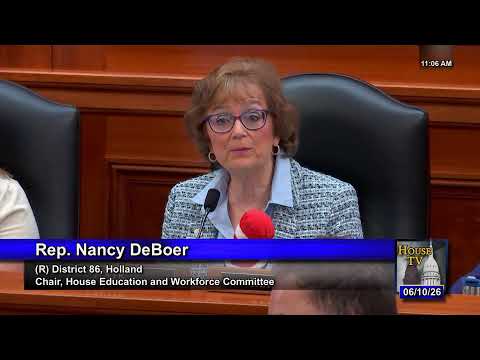
House Education panel advances multiple teacher-training and education bills
Summary
The House Education and Workforce Committee approved substitutes for several education bills covering behavioral analysis services, science-of-reading instruction and literacy professional development and reported multiple bills to the rules committee or with recommendations following roll calls.
The House Education and Workforce Committee on a routine agenda advanced a set of education measures, adopting substitutes and reporting several bills out of committee.
Vice Chair Linting moved to adopt an H-3 substitute to House Bill 50 44 that narrows the bill to medically applied behavioral analysis services, delays implementation by one year and corrects a grammatical error; the clerk recorded the substitute vote as '11 ayes, 0 nays, 0 pass.' The committee later reported that substitute with recommendation in a full roll sequence called by the clerk during committee business.
The committee also adopted an H-2 substitute to House Bill 56 46 requiring instructors in traditional and alternative programs to receive science-of-reading training; the roll call associated with that substitute was recorded in the transcript roll as passing (roll counts reported in the hearing sequence). Representative Colazar’s H-3 substitute to House Bill 56 97 — which expands eligibility from a single provider to multiple providers for literacy professional-development training, allows the department to consult with providers on the implementation schedule and gives transferees up to three years to complete training — was explained on the floor and adopted by roll call.
Vice Chair Linting moved to report House Bill 59 57 (H-1 substitute) and House Bill 60 16 with the recommendation that they be referred to the committee on rules; the clerk called roll and the motions were recorded per the committee’s roll sequences.
Clerk-read witness cards during the meeting showed multiple stakeholders on record for and against various items: school-district representatives, the Michigan Association of School Psychologists, the Michigan Association of School Boards and business groups, among others, submitted positions on bills under consideration.
The committee proceeded through its agenda, calling and resolving each roll-call motion in sequence before adjourning.
What’s next: Most bills moved with committee recommendations or referrals to rules; sponsors and staff will follow the established rule and calendar processes for next steps in the House.