Get Full Government Meeting Transcripts, Videos, & Alerts Forever!
Get email alerts on the Special Education Graduation topic
No spam. Unsubscribe anytime.
MDE data links suspensions and placement to lower graduation rates for students with disabilities
Summary
State education officials told the State Board that 11th-grade proficiency and 4‑year graduation gaps for students with disabilities are substantial, that 9th‑grade suspensions sharply raise dropout risk, and that the department will use ISD capacity‑building visits, MTSS/PBIS strategies and 30/60/90 plans to boost inclusive instruction and graduation outcomes.
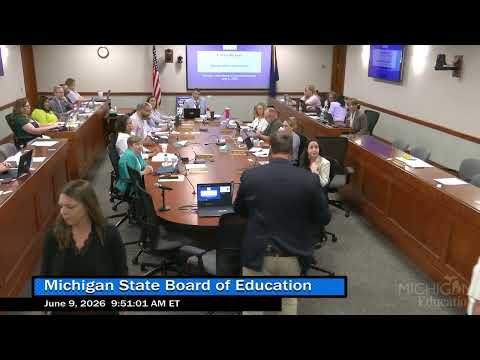
Michigan Department of Education officials told the State Board of Education on June 9 that students with disabilities lag far behind their peers on college‑readiness measures and graduation rates, and that early suspensions and lower time spent in general education are linked to those outcomes.
Deputy Superintendent Lauren Carter Enzoma said statewide assessment data show a stark gap: 11th‑grade reading proficiency averaged about 52 percent for general education students versus 13 percent for students with disabilities; for mathematics the averages were roughly 29 percent and 4 percent, respectively. "The data is very clear," Carter Enzoma said. "The more time students are with their non‑disabled peers and receiving grade‑level instruction, the better their graduation outcomes." She added that roughly 215,449 students received FAPE in 2025, representing about 15.17 percent of Michigan students.
Presenters highlighted 9th‑grade suspension as a major inflection point. Dr. Delsa D. Chapman, who led a portion of the briefing, said students with zero suspensions show an 11 percent chance of dropping out, while students with four or more suspensions face about a 40 percent dropout chance. Chapman told the board those suspension patterns correlate with lower on‑time graduation and postsecondary enrollment rates.
Chantelle Moston, an education consultant in the Office of Special Education, walked the board through IDEA terms such as FAPE and LRE and described the department's implementation work. MDE has completed capacity‑building site visits under the "Faith in the LRE" initiative (to date, presenters said, covering 19 ISDs and 186 member districts with 1,964 data‑gathering interviews) to inform targeted change. The visits feed an improvement cycle in which ISDs will develop 30/60/90‑day action plans grounded in local data and stakeholder input.
The department outlined actionable strategies: expand multi‑tiered systems of support (MTSS), strengthen positive behavioral interventions and supports (PBIS), use early warning and intervention monitoring systems (EWIMS) as alternatives to suspension, deepen high‑quality job‑embedded professional learning and coaching, and improve individualized evaluation and IEP development. "We have to strengthen meaningful collaboration between general and special education providers," Carter Enzoma said. "This work is not one office's job; it requires ISDs, districts, parents and partners."
Board members asked for more disaggregated and categorical data. Board member Ellen C. Lipton asked whether the presented charts break down outcomes by disability type and suspension reason; staff said more detailed breakdowns exist and will be used in local work and monitoring. Lipton and others also raised resource and staffing disparities across ISDs; Carter Enzoma acknowledged chronic underfunding for special education and said resourcing affects the ability to implement high‑quality instruction and to recruit and retain paraprofessionals and specialized staff.
Board members sought timelines. MDE noted a dual pace: a six‑year federal monitoring cycle required by the Office of Special Education Programs will guide formal supervision activity, while the department is already engaging in immediate facilitated conversations, technical assistance and locally focused 30/60/90 action plans to accelerate improvements.
The presentation concluded with the department's plan to curate guidance materials in a single web portal, elevate promising practices (for example, co‑teaching and restorative practices), and deepen professional learning that teachers say they need. Officials characterized the mix of capacity building, local action planning and monitoring as the pathway to raise graduation rates for students who receive special education services.
What happens next: MDE staff said they will continue facilitated conversations with ISDs and professional organizations, publish curated resources, and follow up with technical assistance and action‑plan monitoring.