Get Full Government Meeting Transcripts, Videos, & Alerts Forever!
Get email alerts on the Land Use Rezoning topic
No spam. Unsubscribe anytime.
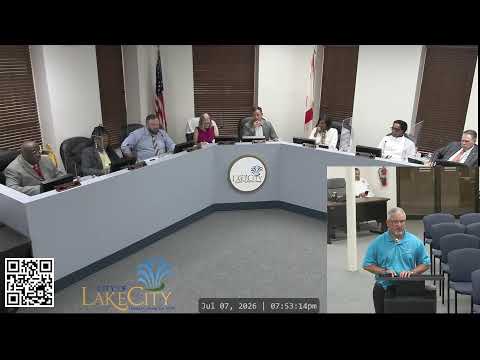
Lake City council tables Early Street rezoning after residents raise traffic and safety concerns
Summary
Neighbors opposed a request to raise density on two parcels on Early Street; the applicant agreed to meet with residents and the council voted to table the related comp plan amendment and rezoning ordinances to August 2026 to allow community discussion.
The Lake City Council on July 7 tabled two ordinances proposing higher-density residential development on Early Street after a heated public hearing in which neighbors raised concerns about traffic, compatibility and crime.
At a public hearing convened for ordinance 2026-2373 (CPA 2606), residents described Early Street as a short, established neighborhood and urged the council to preserve its character. Barbara Meisel Perry told the council the street is “less than a half mile long” and said the previously approved nearby development has already strained traffic. Sandy Gates, who said she recently bought a house at 619 Northwest Early Street, told the council the planned apartments would be “in my front yard” and described fears about increased traffic and crime. Fred Dace, who said his church is located nearby, urged the council to prefer single-family homes rather than apartments.
David M. Winsberg, the applicant and a licensed engineer, said he owns two parcels and requested a future-land-use change that would increase maximum density on the east parcel from a current entitlement of 20 units to up to 50 units. Winsberg told council members he had prepared trip-generation, water, sewer and solid-waste calculations as part of his application and said the estimated increase in PM peak trips would be roughly 18.6, not the “several hundred cars” some speakers feared.
Councilmembers pressed Winsberg on whether he had reached out to adjacent residents before filing the application. Growth management staff member Thomason offered to facilitate neighborhood meetings between the applicant and homeowners so parties could explore alternatives such as duplexes or reduced unit counts. Winsberg said he would meet with neighbors.
After discussion, Councilmember Carter moved and the council seconded a motion to table both ordinances (items 7 and 8) until a future meeting in August 2026 to allow the applicant and residents to meet and attempt to reach a compromise. The motion carried on a roll-call vote.
The council emphasized that tabling the items preserves the applicant’s right to pursue development while giving residents a structured opportunity to raise concerns and seek adjustments to the proposal before the council acts again. Planning staff said formal site plans and any required technical studies would return for review later in the process if the applicant proceeds.
The ordinances remain withdrawn from tonight’s agenda and will return only after the applicant and staff report back on community meetings and any agreed changes.