Get Full Government Meeting Transcripts, Videos, & Alerts Forever!
Get email alerts on the Public Health topic
No spam. Unsubscribe anytime.
Oregon City staff urge countywide approach to flavored nicotine ban amid enforcement and litigation concerns
Summary
City staff recommended sending a draft letter to neighboring cities and Clackamas County to pursue a coordinated flavored nicotine ban after researchers warned a city-only ordinance could prompt lawsuits; commissioners asked for more enforcement-cost details and clarity on including synthetic nicotine (ZYN).
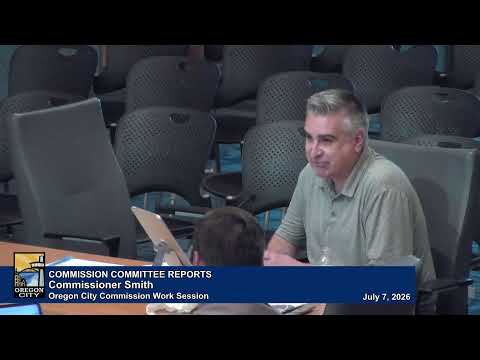
City Attorney Carrie Richter told the Oregon City Commission on July 7 that staff research favors a coordinated, county-level approach to banning flavored nicotine and tobacco products because a stand-alone city ordinance would be vulnerable to legal challenges.
“It was all going along smoothly until I got to the enforcement part,” Richter said, adding that “everybody we talked to, the initial response was if Oregon City does this alone, they're going to get sued.” She said staff met with Clackamas County Public Health and officials in Washington County, and had begun drafting a memo and a draft letter the commission could send to neighboring cities and the Clackamas County Board of Commissioners.
Why it matters: Richter said local data show high youth use of flavored nicotine products and that Oregon City’s retail density is notable — staff reported 30 licensed tobacco shops in city limits, three of them vape-only — and that local maps show many shops near schools in ways that could limit the effectiveness of modest zoning setbacks.
Commissioners expressed broad agreement about policy goals — limiting youth access to flavored nicotine — but raised practical questions about enforceability and cost. Commissioner Adam said a countywide ordinance would likely be more effective, noting Washington and Multnomah counties provide alternate enforcement models. “If it's going to be effective, it's going to be something that's more than just the city,” he said.
Staff outlined two enforcement models they observed elsewhere: Washington County’s approach ties a surcharge to tobacco licensing and relies largely on complaint-driven enforcement by local code officers; Multnomah County, which manages licensure and inspections directly, allows inspection-driven enforcement. Richter and commissioners discussed whether a county adoption with city-level enforcement in incorporated areas — and funding via license surcharges — could provide both stronger compliance and a defensible enforcement mechanism.
Another central question was whether the ordinance should explicitly include synthetic oral nicotine products such as ZYN. Richter said public-health partners recommended inclusion. Richter cited a CDC Foundation study staff reviewed showing a sharp increase in youth use between 2022 and 2025 and reported that roughly 94 percent of recent oral nicotine users reported using flavored products.
Next steps: Commissioners agreed staff should send a draft letter to the mayor for distribution to other cities in Clackamas County (staff suggested including Lake Oswego, Happy Valley, Gladstone and Milwaukie as likely partners) and ask interested cities to respond within roughly a month. The commission directed staff to gather more information about enforcement costs and the licensing surcharge model and to return the draft for approval at the next regular meeting.
The commission did not take a formal vote but supported pursuing the county outreach and additional enforcement detail at a future regular meeting.