Tualatin staff seek commission input on prioritizing five-year climate work plan
Summary
City climate staff presented a draft prioritization framework for a five-year work plan to implement Tualatin's 2024 Climate Action Plan, emphasizing climate impact, co-benefits, feasibility and timing; commissioners urged higher weighting for hazard-risk reduction and better integration with downtown revitalization projects.
Amanda Watson, the city's climate action program manager, asked the Tualatin Planning Commission on June 17 to help prioritize which of the Climate Action Plan's 100-plus recommended actions the city should pursue over the next five years.
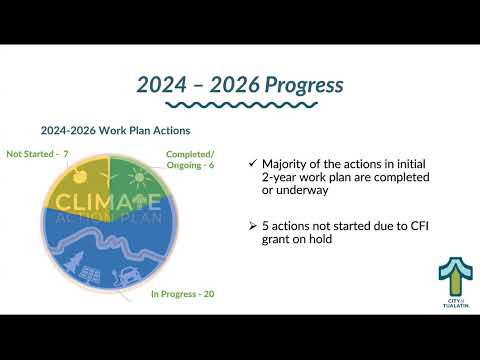
The Climate Action Plan, adopted by the City Council in 2024, sets twin goals: reach net-zero greenhouse gas emissions by 2050 and prepare the community for climate impacts. Watson said staff completed an initial two-year work plan of 33 actions; most are complete or in progress, while several remain unstarted pending external funding. "We had an initial 33-action work plan and most of those actions are either completed, ongoing or well underway," she said.
Why it matters: the prioritization will shape staff work and budgeting that inform next year's city budget and council goals. Watson told the commission the city developed draft criteria staff plans to apply to all actions to identify a short list for the next five years: climate impact (emissions reduction or hazard-risk reduction), co-benefits (jobs, health, equity), alignment with council goals and master plans, feasibility (staff capacity, funding, community support), implementation cost, and opportuneness/timeliness (grant windows or sequencing requirements).
Commissioners pressed staff on which types of actions should be elevated. Several commissioners said hazard-risk reduction'particularly flood and wildfire resilience'should be prioritized given limited resources. "I'm imagining we're going to have very limited resources for the near term, so climate hazard risk reduction might be something I would put higher on that prioritization," one commissioner said. Watson responded that staff is coordinating with downtown revitalization and Riverfront Park planning so climate goals and flood considerations can be integrated into those capital projects.
Staff identified funding sources that already help sustain climate work, including an opt-out 99-cent "pennies for climate action" utility fee and a 0.3% increase in PGE's franchise fee dedicated to climate work. Watson also said a federal grant intended to support EV charging and related transportation electrification is currently held up at the federal level, limiting near-term progress on some actions.
Commissioners also asked how the city will measure progress. Watson said the city has a baseline greenhouse-gas inventory (prepared in 2022 or 2023) and plans to update inventories every five years; utility data, vehicle-miles-traveled metrics and building energy-use intensity will feed future measurements. "We don't have the updated inventory yet, but we will be doing one on a five-year schedule," Watson said, offering to provide baseline numbers to commissioners by email.
What happens next: staff will apply the commission's feedback to finalize prioritization criteria, produce a short list of five-year actions and develop metrics. Watson said the goal is to complete the five-year prioritized work plan within the calendar year so it can inform the city's 2027 budget and council goal-setting process.
No formal vote was taken at the meeting; commissioners provided direction and asked staff to maintain public coordination and integrate climate priorities into other city projects.
AI generated
The text on this page is AI generated. Summaries, highlights, analysis, and video transcripts are all produced from the original source material.
AI can make mistakes, so if you spot one, and we will fix it for everyone.
Note: the source content is unaltered by us. Any content source we link to, be it a video, an audio recording, or a document, is presented exactly as its publisher released it. That publisher is usually a government body, sometimes an individual official or another organisation.