Get Full Government Meeting Transcripts, Videos, & Alerts Forever!
Get email alerts on the Police Oversight topic
No spam. Unsubscribe anytime.
Springfield police oversight board outlines discipline role, body‑camera review and new officer support program
Summary
At its annual meeting on March 18, the Springfield Board of Police Commissioners explained its role in disciplining officers, described how it reviews body‑worn camera footage and said a new stress‑reduction program for officers has started. Commissioners urged residents to file written complaints to trigger formal review.
The Board of Police Commissioners met March 18 at the Ray Ray Jordan Senior Center and reiterated that its primary role is disciplining Springfield Police Department employees when alleged misconduct exceeds the superintendent's administrative threshold.
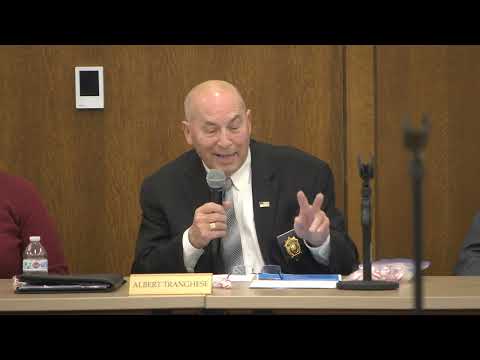
Albert Trangisi, chair of the Board of Police Commissioners, said the board’s work “is basically like a trial” when an officer faces serious discipline: attorneys and witnesses appear, the board reviews evidence and then decides whether to suspend or terminate. “Any discipline in the Springfield Police Department is done by this board unless it's less than 5 days suspension,” Trangisi said.
The board highlighted how body‑worn video and internal reports are used as evidentiary material. Madeline Fernandez, a commissioner who also serves on the department’s use‑of‑force committee, said she reviews camera footage as part of case review and has found that “everything that I'm seeing matches the body cameras.” Fernandez added that any instances where cameras are off are “addressed immediately” and that there is formal discipline for failing to activate cameras when required.
Commissioners also described a new officer support program aimed at addressing stress and mental‑health strain. Trangisi said the program, led by Lieutenant Kenny, has begun with a first cohort of 19 officers and is intended to reduce on‑the‑job stress so officers can remain effective in the field.
Community advocates raised questions about complaint volume and transparency. Tracy Carpenter of the Mass Senior Action Council noted that complaint totals fell from 76 in 2024 to 65 in the current report and asked how trends are being tracked; commissioners said quarterly oversight reports are posted on the city website and that the board’s work should be integrated into a public data dashboard. “It’s really important when you do have any sort of complaint ... fill this out because a paper trail is everything,” Carpenter said.
The board explained the relationship between local review and the state oversight body: “All of our cases are sent to POST after we settle,” Trangisi said, referring to state review; residents may also file with POST directly. Commissioners emphasized that while they can forward community concerns to the superintendent for enforcement or departmental action, operational decisions such as traffic enforcement remain the superintendent’s purview.
The meeting closed with routine business and a motion to adjourn. Several commissioners noted that discipline outcomes can include unpaid suspensions and terminations where warranted, and board members encouraged residents with officer complaints to submit written reports so investigations can proceed.