Get Full Government Meeting Transcripts, Videos, & Alerts Forever!
Get email alerts on the Infrastructure.bridges.sagamore topic
No spam. Unsubscribe anytime.
MassDOT says design‑build procurement launched for new Sagamore Bridge; environmental reviews near final signoff
Summary
MassDOT told Barnstable County leaders it has launched a design‑build procurement for a replacement Sagamore Bridge, has $1.2 billion in federal grants lined up, expects state and federal environmental reviews to conclude this summer, and plans visible foundation testing and additional property acquisitions before construction begins.
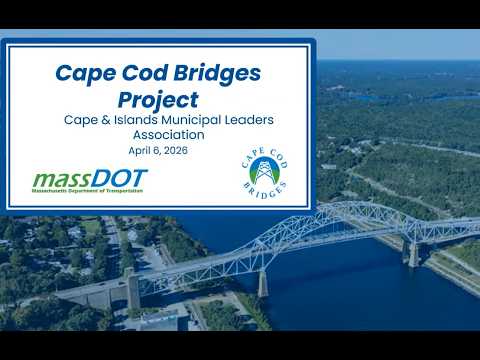
Massachusetts Department of Transportation officials told a special joint meeting of Barnstable County leaders that they have launched a design‑build procurement for a replacement of the Sagamore Bridge and are nearing the end of required state and federal environmental reviews.
"We have the funds lined up," Luisa Pawanski, executive director of MassDOT’s Division of Mega Projects, said during the presentation. She said MassDOT issued a request for letters of interest and will follow with a request for qualifications and an RFP that will allow the agency to select a design‑build team and issue a notice to proceed.
Pawanski told the assembled municipal leaders and county commissioners that MassDOT has filed a final Environmental Impact Report under the Massachusetts Environmental Policy Act and expects the state certificate closing the EIR soon. On the federal side, she said the final Environmental Impact Statement is under review by cooperating agencies, and MassDOT expects a record of decision at the end of June with publication in the Federal Register in July.
Why it matters: MassDOT officials said they must complete the RFP phase before shifting $1.2 billion in federal grants to state accounts and issuing a notice to proceed to the winning design‑build joint venture. Pawanski said the RFP phase will take about a year and will include alternate technical concepts from bidders to demonstrate schedule or cost advantages.
MassDOT described several near‑term actions that will be visibly noticeable to residents. The agency said it has been conducting borings, surveys and subsurface investigations on public and private land to inform foundation design; mass foundation load tests and pile driving will increase noise and visible activity in the coming weeks and months. Pawanski said that work is necessary to design foundations intended to last 75 to 100 years.
On right of way, Pawanski said the agency has identified 13 residential properties for takings related to the Sagamore replacement and has acquired 11 of those homes, with the remaining two expected to be acquired. She said MassDOT provides financial compensation and relocation support to property owners and is also addressing commercial takings and numerous smaller easements.
Cost and schedule controls were a recurring focus. Pawanski acknowledged statewide construction inflation and rising steel prices and said MassDOT has conducted and will conduct voluntary cost‑schedule‑risk analysis workshops with the Federal Highway Administration and has commissioned an independent cost estimate to guard against underbudgeting and schedule risk. She said MassDOT is handing bidders a comprehensive preliminary design and the same geotechnical data so all teams bid from the same information.
On the Bourne Bridge, Pawanski said MassDOT applied for a federal grant exceeding $1 billion and had not yet received notice of an award; she added that the U.S. Army Corps of Engineers will perform maintenance and preservation work on the Bourne Bridge while funding decisions are pending.
Timeline highlights and expectations given in the presentation included an industry day on April 17 for designers and contractors (MassDOT estimated 200–250 attendees and said more than 100 had already registered), a letters‑of‑interest deadline of May 27, an anticipated notice to proceed in late fall 2027, and the start of construction in winter 2027–28. Pawanski also said traffic management planning aims to keep two lanes in each direction open during much of the work and that the replacement Sagamore will be built as twin spans to allow traffic shifting and staged demolition and reconstruction.
Local officials asked about coordination with utilities and pipeline relocations necessary before construction. Pawanski confirmed that utilities — including an Algonquin pipeline relocation under the canal — must be completed and that MassDOT is coordinating closely with utility owners to perform early field work to simplify later construction.
Pawanski closed by saying the governor and lieutenant governor have prioritized the bridges, that the governor has contributed more than $700 million to the project, and that MassDOT will return to update local leaders as it hits future milestones.
The special meeting adjourned after public Q&A; no formal votes or motions were taken.