Get Full Government Meeting Transcripts, Videos, & Alerts Forever!
Get email alerts on the Variance Pavilion topic
No spam. Unsubscribe anytime.
Board approves after‑the‑fact variance for pavilion in Riverwood East, requires building permit
Summary
The St. Tammany Parish Board of Adjustment voted 4–1 to allow a 300‑sq‑ft open pavilion to remain 0.3 feet from a side property line and to exceed lot‑coverage limits, conditioning approval on the applicant filing an after‑the‑fact building permit and complying with building‑permit review.
The St. Tammany Parish Board of Adjustment approved an after‑the‑fact variance on case 20264679 to allow a 300‑square‑foot open pavilion to remain near the property line at 24 Sydney Court in the Riverwood East subdivision, with the approval conditioned on the applicant filing for an after‑the‑fact building permit.
Parish staff told the board that no specific hardship had been demonstrated but that letters of no objection had been submitted by surrounding property owners and that gutters and underground drainage had been installed to improve drainage. "Should the board be in favor of the variance, it should be subject to applying for an after the fact building permit for the gazebo," staff recommended.
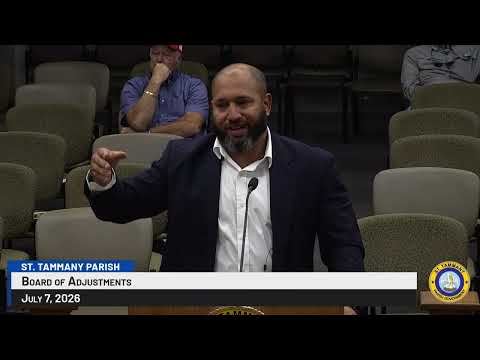
Jason Michael Fries, who identified himself as the applicant and as a local attorney and property owner, apologized to the board for constructing the pavilion without first seeking approval. "I thought because it was an open pavilion, that, you know, I didn't need to...jump through these hoops," Fries said, adding that he installed subsurface drainage and gutters and engaged an engineer to address chronic standing water at the rear of the lot.
Fries said he received letters of support from all but one adjacent neighbor and that the one neighbor he did not approach had prior arrests and was not present. He told the board he had explored moving the structure but that contractors said it was not feasible and estimated relocation or reconstruction would cost about $15,000.
Engineer Sean Lettig (introduced by the applicant) described two French drains and subsurface tie‑ins that feed into the neighboring property owner’s drainage and said the system has been effective except during an unusually long rain. Several board members pressed Fries on whether the pavilion could be relocated and whether the contractor should reimburse removal or reconstruction costs; Fries said he would seek recourse against the contractor if possible.
Board members noted precedent and past cases where structures had been ordered removed. One former board member who attended the meeting criticized what he called a pattern of post‑construction variance requests and warned the board that building‑code issues are separate from zoning variances. The chair responded that building‑code compliance will be resolved when the applicant submits permit plans for review.
A motion to approve the variance "as requested" and to require the applicant to apply for an after‑the‑fact building permit was moved by Mr. Glockner and seconded by Mr. Swindell. The clerk announced a 4–1 vote in favor and the motion passed.
The board’s approval allows the pavilion to remain while the owner pursues the required after‑the‑fact permit; the building‑permit review and any building‑code or fire‑code issues will be resolved by the parish permit reviewer after submission. The board also discussed training to better explain the differences between zoning variances and building‑code enforcement for future meetings.