Get Full Government Meeting Transcripts, Videos, & Alerts Forever!
Get email alerts on the Employee Health Insurance topic
No spam. Unsubscribe anytime.
Commission accepts consultant's recommendation for fully insured plan; consultant declines to recommend self-funding
Summary
After reviewing proposals from multiple vendors, Cyber Insurance Consultants recommended the FMIT/UnitedHealthcare plan 6 for Jackson County's employee health coverage; the consultant said she could not recommend self-funding at this time, and the board voted to accept the recommendation.
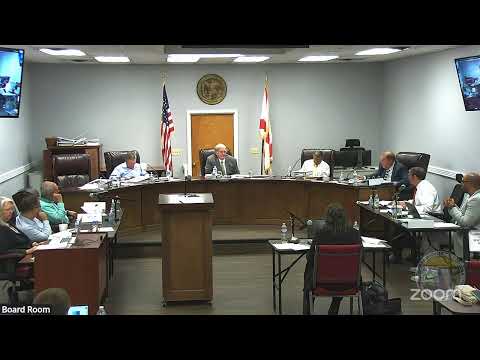
The Jackson County Commission voted to accept its consultant's recommendation to pursue a fully insured employee health plan through an FMIT (Florida League) option using the UnitedHealthcare network (plan 6), after a detailed presentation of proposals and a discussion about the risks and mechanics of self-funding.
Laura Ripka, a consultant with Cyber Insurance Consultants, told commissioners the county's RFP (released April 27 with a June 4 return date) drew multiple fully insured proposals and several self-funded bids. Ripka said the county paid roughly $5.7 million in claims in 2025 and that self-funding would require actuarial certification and reserves (she estimated reserves in rough terms at about 60—60 days, which the consultant described as approximately $1.25 million). For those reasons and because the fully insured proposals were competitive, Ripka said, "At this time, we are not recommending a self funding plan."
Ripka reviewed provider-network disruption, cost-share comparisons for employees and transition timelines. She said her recommendation would preserve most employees' current provider access and customer-service continuity; the recommended plan would slightly increase annual premiums but keep coverage comparable to the county's incumbent carrier.
Vendor representatives and other insurance professionals queried the analysis. Michael Rich of Boyd Insurance, who responded on the self-insured side, told commissioners that self-funding "can arrest this every climbing trajectory of premium" and urged a future study of properly structured self-funded options with turnkey administration and cost-containment measures. Ripka and county staff acknowledged those possibilities but emphasized the differences in fiduciary responsibility and the need for actuarial certification, stop-loss insurance and administrative capacity before recommending a self-funded switch.
Commissioners discussed employee affordability concerns (especially for lower-paid staff who pay family-premium differences), the county's health-reimbursement-account (HRA) arrangements and telehealth options available to employees. Staff said the county currently funds single-coverage premiums and that employees pay the difference for family coverage; the county also provides an HRA card pre-funded for co-pays and offers a telehealth program at no cost to employees.
A commissioner moved to accept Cyber Insurance Consultants' recommendation to proceed with the FMIT/UnitedHealthcare plan 6 and to retain the county's broker to help manage transition and enrollment. The motion was seconded and passed on a voice/hand vote. Staff said the transition would follow vendor timelines, with open enrollment planned for October and an expected 30—60 day implementation period depending on negotiation details.
The consultant offered to provide follow-up support and to answer implementation questions as staff negotiates contract terms.