Get Full Government Meeting Transcripts, Videos, & Alerts Forever!
Get email alerts on the Adu Regulations topic
No spam. Unsubscribe anytime.
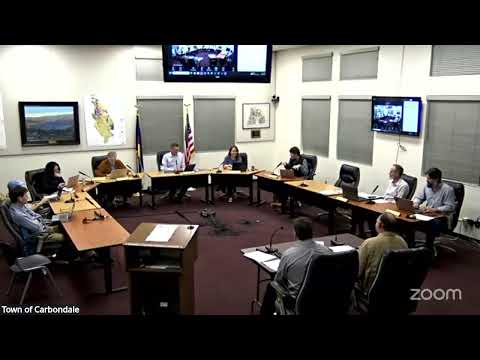
Carbondale trustees refine proposed ADU rules, continue hearing to March 24
Summary
The Board of Trustees reviewed a staff-backed package to streamline accessory dwelling unit (ADU) approvals, expand where ADUs are allowed and raise size and bedroom limits; trustees asked staff to return March 24 with revisions after public comment on parking, density and building-code retrofit costs.
Carbondale's Board of Trustees on March 10 reviewed a comprehensive package of proposed changes to the town's accessory dwelling unit rules aimed at simplifying approvals and expanding where ADUs are permitted.
Planner Jared told trustees that the proposal would create a three-tier review system: internal ADUs processed straight to a building permit, smaller ground-level ADUs processed administratively, and larger or potentially impactful ADUs handled through a public hearing before the planning and zoning commission. "ADUs in Carbondale are currently governed by a combination of the unified development code, the UDC, planned unit developments, PUDs, and sometimes private covenants," Jared said, summarizing why the update is needed.
The draft would allow ADUs in all residential zone districts, permit attached and detached units, increase allowable size to up to 40% of the primary dwelling (to a 1,000-square-foot cap) and raise the bedroom limit from one to two to support a broader range of households. Staff also proposed 1 parking space per bedroom with discretion for reductions, adoption of Appendix BC of the 2024 International Residential Code, and a pathway for some existing nonpermitted units to legalize within a defined timeframe.
Public commenters urged caution. Susan Ray warned that allowing "everyone to build an ADU that wants to build an ADU is going to change the character of a neighborhood a lot," and raised parking and density concerns in her Wheel Circle neighborhood. Richard Stumpf urged flexibility in building-code requirements so that retrofits can be legalized affordably: he noted some building-code provisions (separate mechanical or plumbing services) can make legalization prohibitively expensive and asked the town to avoid turning a modest retrofit into a six-figure project.
Trustees worked through several possible refinements. They agreed to narrow the proposed higher-review triggers: instead of using a 20-foot property-line buffer as a default trigger, they gave staff direction to make tier-3 review apply only to units larger than about 850 square feet or units taller than the primary structure. Trustees also signaled support for allowing ADUs across residential zones and for increasing size and bedroom allowances, and they said they did not want to ban short-term rentals for ADUs (preferring to manage STRs through the town's existing short-term rental regulations).
The board floated a parking approach — no required parking for one-bedroom ADUs and a single required space for two-bedroom ADUs — but left the final decision for staff to refine. Trustees deferred the complicated issue of impervious-lot-coverage changes and possible PUD amendment procedures for later, asking staff to return with revised code language and clearer options.
Next steps: trustees voted to continue the public hearing to March 24, directing staff to bring back a revised draft that reflects the board's guidance so far. If approved after further revision, the changes would be incorporated into the town code and building-permit processes.
What happens next: the trustees asked residents and stakeholders to submit written comments to the trustees' general email address to be part of the public record ahead of the March 24 meeting.